
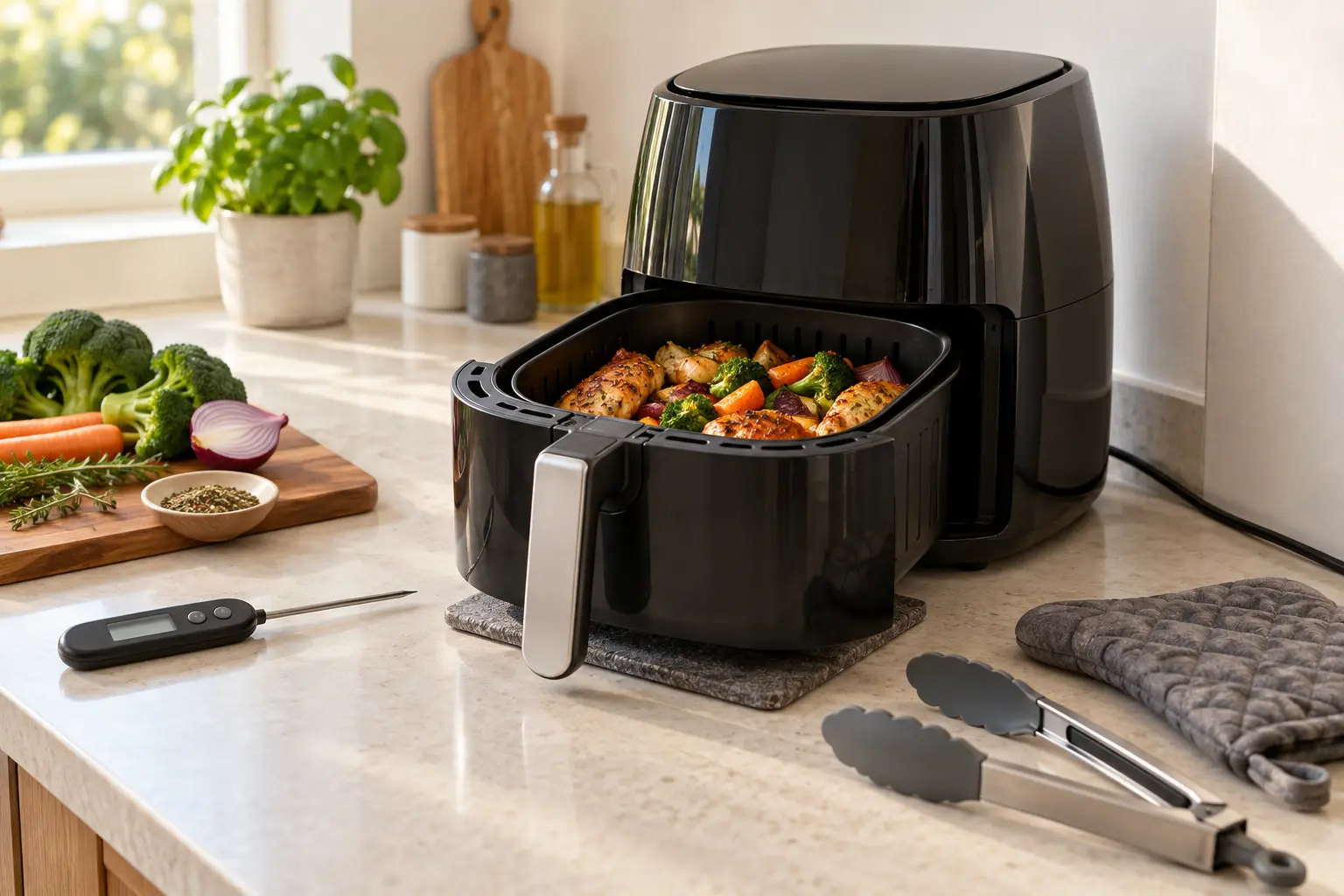
Short answer: air fryers are generally safe when the appliance is undamaged, correctly positioned and used according to its manual. They do not make food automatically healthy or risk-free. The points that matter are the condition of the basket and electrics, safe internal food temperature, avoiding excessive browning, controlling grease and keeping liners away from the heating element.
The question “Are air fryers safe?” hides several different concerns. Some people mean the non-stick coating. Others are worried about cancer, toxic fumes, liners, undercooked chicken or an appliance fire. Those risks should not be mixed into one dramatic yes-or-no claim.
This guide separates them. It uses current US and European food-safety guidance and focuses on the choices you can actually control at home.
Are air fryers safe and healthy?
Safe and healthy are related, but they are not the same thing. An air fryer is a compact convection oven: an electric heating element and fan move hot air around the food. It can cook with much less added oil than deep frying because the food is not submerged in oil. That can reduce added fat when the food and portion are otherwise comparable.
But the appliance does not transform every ingredient. Air-fried vegetables, fish or minimally processed potatoes can fit a balanced diet; a large portion of highly salted frozen snacks remains a large portion of highly salted frozen snacks. Safety also depends on whether raw food reaches a safe temperature—not on whether the outside looks crisp.
Appliance safety
Sound cord and plug, stable placement, correct clearance, no active recall and no melting, sparking or uncontrolled overheating.
Food safety
Clean handling, no cross-contamination and a food thermometer for meat, poultry, seafood and reheated leftovers.
Material safety
An intact food-contact surface, suitable accessories and use within the basket’s temperature and cleaning instructions.
Cooking chemistry
Avoiding heavily browned or burnt starchy foods helps limit acrylamide, regardless of whether you use an oven, fryer or air fryer.
Are air fryers toxic?
No credible evidence shows that a normal, correctly functioning air fryer is inherently “toxic.” It uses resistance heat, not ionizing radiation, and it does not cook food with microwaves. The relevant questions are more specific:
- Is a coating scratched, bubbling or peeling?
- Is food or grease burning and producing smoke?
- Is a plastic component melting or touching a hot zone?
- Is a liner or accessory rated for the temperature?
- Has the exact brand and model been recalled?
A mild “new appliance” odor can come from packaging residue or manufacturing oils during initial use, but a persistent chemical smell should not be dismissed. Switch the air fryer off, unplug it when safe, ventilate the room and let it cool. Check for leftover packaging, protective film, food debris or damaged parts before following the manual’s first-use procedure. Stop using it and contact the manufacturer if the odor returns, plastic deforms, the plug becomes unusually hot, or visible smoke comes from the appliance rather than the food.
Is an air fryer non-stick coating safe?
Many baskets use PTFE-based or ceramic-style non-stick coatings. An intact coating used within the manufacturer’s temperature and cleaning limits is not the same situation as a surface that is peeling or exposing metal. “PFOA-free” also does not mean “PTFE-free.”
The US Food and Drug Administration says authorized fluoropolymer non-stick coatings are polymerized and tightly bound to cookware and that studies show negligible migration of PFAS capable of moving into food from those coatings. If you prefer to avoid an applied fluoropolymer coating, look for a clearly documented PTFE-free, PFAS-free, bare glass or uncoated stainless-steel food-contact surface.
Stop using a basket or crisper plate that is peeling, blistering, flaking, deeply scratched through to the base metal, rusty or warped. Our air fryer non-stick coatings guide explains PTFE, PFOA, PFAS, ceramic and replacement thresholds in detail.
Do air fryers cause cancer?
There is no evidence that the air fryer appliance itself causes cancer. The real issue behind this question is usually acrylamide, a chemical that can form naturally when certain starchy plant foods—especially potatoes and grains—are cooked at high temperatures.
Acrylamide is not unique to air frying. The FDA says it can form during frying, roasting and baking. The US National Cancer Institute reports that animal studies found cancer at experimental exposures, while a large number of human epidemiological studies have found no consistent evidence that dietary acrylamide is associated with cancer.
That uncertainty is a reason to reduce unnecessary exposure, not a reason to claim that every air-fried potato is dangerous. Acrylamide formation varies with the ingredient, storage, temperature, cooking time and final color. Studies comparing air frying with other methods have produced different results, and EFSA notes that some industry and consumer tests found more acrylamide in hot-air-fried foods than in conventional deep-fried foods. “Air fried” is therefore not an automatic low-acrylamide guarantee.
Practical rule for potatoes and bread: aim for golden yellow or light brown, not dark brown. The FDA also advises storing potatoes in a cool, dark place rather than the refrigerator and notes that soaking raw potato slices in water for 15–30 minutes before cooking can reduce acrylamide formation. Drain and dry them before cooking.
Can an air fryer give you food poisoning?
Yes, if food is undercooked or handled poorly. Fast browning can make the outside look ready while the center remains below a safe temperature. Crowding a basket, cooking thick frozen portions, failing to turn food and relying only on the timer can all create cold spots.
The USDA specifically advises measuring air-fried foods with a food thermometer. Check the thickest part without touching bone or the basket:
| Food | Safe minimum internal temperature | Important detail |
|---|---|---|
| Chicken, turkey and other poultry | 165°F / 74°C | Check the thickest part; the same minimum applies to ground poultry. |
| Ground beef, pork, veal or lamb | 160°F / 71°C | Color alone is not a reliable safety test. |
| Whole cuts of beef, pork, veal or lamb | 145°F / 63°C | Rest for at least 3 minutes after cooking. |
| Fish | 145°F / 63°C | Measure at the thickest point. |
| Leftovers and casseroles | 165°F / 74°C | Reheat evenly; stir or turn when practical. |
Keep raw-food tongs, plates and marinades separate from cooked food. Wash removable parts after raw meat or poultry, and clean grease from the basket, drawer and accessible area near the heating element once the appliance is unplugged and cool.
Can air fryers catch fire?
They can. An air fryer is a high-wattage heating appliance, and recalls have documented real fire and burn hazards. For example, the US Consumer Product Safety Commission recalled about two million Cosori air fryers in 2023 because a wire connection could overheat. The lesson is not that every air fryer is unsafe; it is that the exact model and electrical condition matter.
- Check the model number against the CPSC recall database in the US or your national product-safety authority.
- Place the appliance on a stable, dry, heat-resistant counter with the clearance required by its manual.
- Do not place it under low cabinets, against a wall or beside curtains if that blocks hot-air exhaust.
- Plug it directly into a suitable wall outlet unless the manufacturer explicitly permits another arrangement. Do not use a damaged cord or loose outlet.
- Do not run it unattended or leave it operating when you leave home.
- Remove accumulated crumbs and grease; both can smoke and ignite near a heating element.
- Stop using the appliance if the plug, cord or housing becomes unusually hot, sparks, melts or smells electrical.
If there is a fire, switch off the power only if you can do so safely. Do not pour water into a live electrical appliance or onto burning grease. Leave the area and call emergency services if the fire is not immediately contained.
Are air fryer liners safe?
Purpose-made parchment or silicone liners can be safe, but only when used correctly. The biggest avoidable problem is lightweight paper being lifted by the fan into the heating element.
- Use a food-contact liner rated above the selected cooking temperature.
- Follow the air fryer manufacturer’s instructions; some models need uncovered perforations for airflow.
- Never put a loose paper liner in an empty basket during preheating. Food must hold it securely in place.
- Keep every edge below the basket rim and away from the heating element.
- Do not use wax paper, ordinary paper, plastic wrap, paper plates or unknown silicone.
- Replace a silicone liner that becomes sticky, cracked, torn or permanently distorted.
A liner does not make a damaged basket safe, and covering the entire basket can slow cooking or create uneven temperatures. It also cannot replace cleaning: grease can collect under and around it.
Are glass air fryers safer?
A bare glass bowl can remove one concern: there is no applied non-stick coating on that bowl. It also lets you see browning without opening the appliance. But “glass” does not automatically mean the complete product is safer or healthier.
Check the rack, crisper plate, lid, seals and accessories separately. Glass is heavier and must be protected from drops and thermal shock. Follow the manual on whether a hot bowl may be placed on a cold or wet surface and whether refrigerated glass can go directly into a hot appliance. Electrical construction, temperature control, hot exhaust and recall status remain just as important as the vessel material.
Is it safe to use an air fryer every day?
Regular use is reasonable for most households if the appliance remains in good condition and the diet is varied. Daily use should make you more—not less—consistent about cleaning, inspecting the plug and basket, checking recalls and measuring the temperature of higher-risk foods.
For children, older adults or anyone with reduced mobility, treat the drawer, steam plume and basket as burn hazards. Open the drawer away from the face, use dry oven mitts, place the hot basket on a heat-resistant surface and keep the cord where it cannot be pulled. Children should not use the appliance unsupervised.
When should you stop using an air fryer?
Unplug it and stop using it until it has been checked or replaced when you notice:
- a recalled model number;
- a frayed, crushed or heat-damaged cord;
- a loose, discolored or unusually hot plug or outlet;
- sparks, electrical crackling or repeated breaker trips;
- melting, warping or smoke from the appliance body;
- a fan that stops while the heater continues operating;
- uncontrolled overheating or unreliable temperature controls;
- a basket coating that peels, blisters or exposes bare metal;
- cracked glass or a damaged latch that prevents safe closure.
10-point air fryer safety checklist
- Confirm that the exact model is not subject to a safety recall.
- Read the model-specific clearance, temperature and accessory instructions.
- Use a stable, dry and heat-resistant work surface.
- Keep the air intake and hot exhaust unobstructed.
- Inspect the plug, cord, basket, glass and latch before use.
- Keep loose paper and other combustible material away from the heater.
- Avoid overcrowding and turn or shake food when the recipe requires it.
- Use a food thermometer for meat, poultry, seafood and leftovers.
- Cook starchy food golden rather than dark brown or burnt.
- Unplug and cool the appliance before cleaning away grease and crumbs.
Frequently asked questions
Are air fryers safe to use every day?
For most households, yes—provided the appliance is functioning correctly, has the required ventilation, is kept free of grease and cooks food to safe internal temperatures. Daily use does not compensate for a poor diet or an unrepaired defect.
Do air fryers cause cancer?
There is no evidence that the appliance itself causes cancer. Acrylamide can form in starchy foods during high-temperature cooking, including air frying. Human studies have not found consistent evidence linking dietary acrylamide with cancer, but lightly browning food is a sensible exposure-reduction step.
Are air fryers toxic?
Not inherently. Investigate persistent chemical odors, smoke, melting parts, damaged coatings, unsuitable accessories and recalled or electrically faulty appliances instead of treating “toxic” as one catch-all diagnosis.
Are air fryer liners safe?
Heat-rated, food-safe parchment or silicone liners can be suitable if they do not block necessary airflow or lift into the heating element. Never preheat an empty basket with loose paper inside.
Are glass air fryers safer?
Glass avoids a non-stick coating on the bowl, but it does not remove electrical, burn, fire, food-temperature or accessory-material risks. Check the whole product and follow its thermal-shock instructions.
Can an air fryer catch fire?
Yes. Faults, recalls, blocked ventilation, grease buildup and loose combustible liners can create fire hazards. Keep the appliance attended and stop using it if the cord, plug or housing overheats, sparks or melts.
The bottom line
Air fryers are generally safe, but safety does not come from the words “air fried.” It comes from a sound appliance, intact food-contact materials, correct placement, suitable accessories, safe food temperatures and sensible browning. The most useful habit is to separate the concern: test food temperature with a thermometer, control dark browning, inspect the basket and electrics, clean grease, and check the exact model for recalls.
Official sources used
This article was fact-checked against current official guidance on September 25, 2026. Product designs, recalls and public-health guidance can change, so confirm the instructions for your exact model and country.
- USDA Food Safety and Inspection Service: Air Fryers and Food Safety
- USDA Food Safety and Inspection Service: Safe Minimum Internal Temperature Chart
- US Food and Drug Administration: Acrylamide, Diet, Storage and Food Preparation
- US National Cancer Institute: Acrylamide and Cancer Risk
- US Food and Drug Administration: Questions and Answers on PFAS in Food
- European Food Safety Authority: Acrylamide
- US Consumer Product Safety Commission: Recalls and Product Safety Warnings
Written by Clara Bennett. General consumer information only; it is not medical advice. Follow the instructions supplied with your exact appliance.
About the Author

Clara Bennett
I write practical, model-specific air fryer reviews and comparisons. I focus on usable capacity, household fit, cleaning, materials, day-to-day ownership and value so you can choose the right appliance with fewer surprises.
Read my full profile and review method