
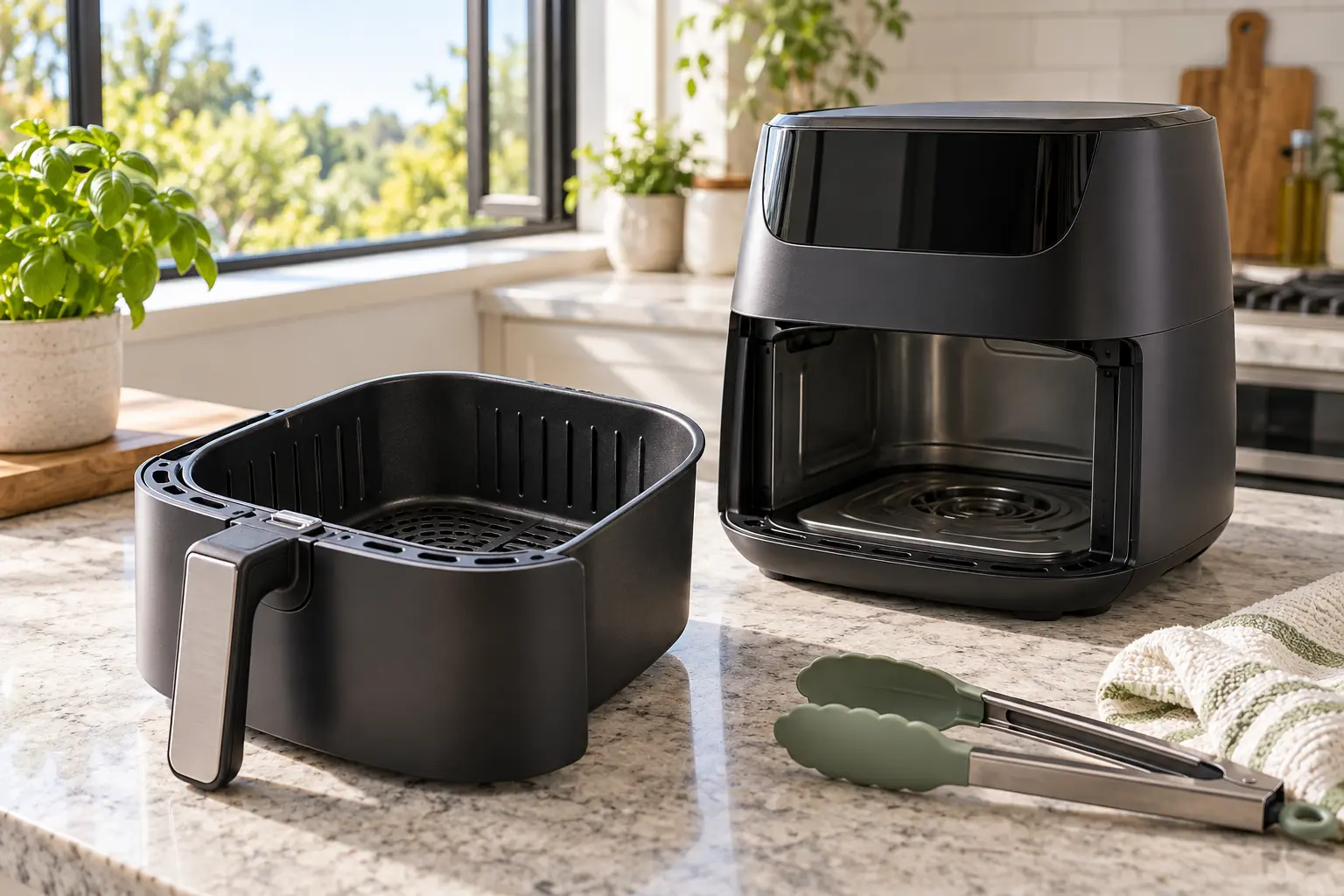
Short answer: air fryers are not inherently toxic. A correctly functioning appliance used within its manual’s limits should not produce dangerous chemical exposure during normal cooking. The realistic concerns are severe overheating, a damaged food-contact coating, burning grease or food, melting plastic, an unsuitable liner, or an electrical fault.
Searches such as “air fryer toxic chemicals,” “air fryer toxic fumes” and “safest non-toxic air fryer” often bundle several different questions together. To answer them well, you need to separate the basket coating from the appliance housing, normal food odors from persistent chemical fumes, and personal material preferences from evidence of a health hazard.
What could “toxic” mean in an air fryer?
Non-stick coating
Many baskets use PTFE; others use ceramic-style coatings, bare metal or glass. Condition and temperature matter.
Overheated fumes
Severe overheating of fluoropolymer coatings or burning plastic can create hazardous decomposition products.
First-use odor
Packaging residue or manufacturing oils may smell briefly, but persistent sharp odors or deformation need investigation.
Food smoke
Grease, crumbs, sugary marinades and food near the heater can smoke even when the appliance itself is intact.
PTFE, PFAS and PFOA: the terms are not interchangeable
PTFE is a fluoropolymer commonly used for low-friction non-stick surfaces. It belongs to the very broad PFAS family. PFOA is a different PFAS that was historically used as a processing aid in some fluoropolymer manufacturing. A basket labeled “PFOA-free” can still contain PTFE, so PFOA-free does not automatically mean PTFE-free or PFAS-free.
The US Food and Drug Administration says authorized non-stick cookware coatings are polymerized and tightly bound, and that studies show a negligible amount of PFAS capable of migrating to food from those coatings. Germany’s Federal Institute for Risk Assessment likewise says adverse health effects are not expected when PTFE cookware is used as intended.
That does not mean every damaged basket should be kept forever. A peeling, blistered, rusty, warped or deeply scratched surface is difficult to clean and no longer performs as designed. Replace the removable part—or the appliance if a safe replacement is unavailable. Our detailed non-stick coatings guide compares PTFE, PFOA, PFAS and ceramic claims.
| Claim or material | What it tells you | What it does not prove |
|---|---|---|
| PFOA-free | The product is represented as not using PFOA | That it contains no PTFE or no PFAS of any kind |
| PTFE-free | No PTFE is claimed in the specified component | That every component is uncoated or that no other PFAS exists |
| Ceramic-coated | Usually a sol-gel non-stick coating rather than PTFE | The complete formula, durability or absence of every additive |
| Glass bowl | No applied non-stick coating on the glass vessel | That racks, seals, lid and other food-contact parts are also glass |
| Stainless steel | A durable uncoated metal surface when genuinely bare | That food will not stick or that every interior component is stainless |
Can an air fryer release toxic fumes?
Any cooking appliance can produce irritating smoke if food, grease or packaging burns. PTFE adds a specific overheating concern: the BfR says hazardous gases can form when PTFE cookware is strongly overheated above about 360°C / 680°F, especially when empty. Normal air fryer set temperatures are far below that figure, but a malfunction, blocked airflow or food contacting the heating element is not normal use.
Polymer-fume exposure can cause flu-like symptoms in people and is especially dangerous to pet birds. If your home has birds, keep them away from the kitchen and follow veterinary and poison-control guidance about heated non-stick products. Good ventilation is sensible for all high-heat cooking.
Stop immediately if you see melting plastic, smoke from the housing or wiring, sparks, repeated breaker trips, a glowing component outside its intended area, or a sharp electrical smell. Switch off, unplug only when safe, ventilate the room and contact the manufacturer or emergency services as the situation requires.
Why does a new air fryer smell like plastic?
A brief odor during first use can come from manufacturing residue, protective oils or packaging that was not fully removed. Before cooking:
- Remove every film, sticker, foam insert and piece of cardboard identified by the manual.
- Wash and dry the removable food-contact parts as directed.
- Inspect the cavity and heating area for packaging without touching a hot or live appliance.
- Follow the manufacturer’s first-use or empty-run procedure exactly; do not invent a hotter or longer burn-off cycle.
- Ventilate the kitchen.
The smell should fade, not intensify. Do not keep “burning it off” if plastic is deforming, the cord or plug is hot, smoke comes from the body, or the odor returns during every use. Record the model and serial number and contact the manufacturer.
Are ceramic or glass air fryers non-toxic?
“Ceramic” generally refers to a silica-based sol-gel coating, not a solid ceramic basket. It can be a PTFE-free choice, but the word alone does not reveal the full formulation, food-contact testing or service life. Treat chips, flaking and exposed base metal as replacement signs.
A glass cooking bowl avoids an applied coating on that vessel and can make the food easy to see. It does not eliminate hot surfaces, electrical risks, smoke, undercooking or materials used in racks, seals and lids. Check whether the glass is designed for the exact appliance and follow thermal-shock precautions.
What is the safest non-toxic air fryer material?
There is no single material that solves every risk. A well-documented appliance with reliable temperature control, recognized food-contact materials and replaceable parts is more useful than a vague “non-toxic” badge.
- Bare stainless steel: durable and coating-free, but may stick and is not used for every component.
- Purpose-designed glass: coating-free on the vessel, but heavier and vulnerable to impact or thermal shock.
- PTFE non-stick: easy to clean and considered suitable for intended use, but must not be severely overheated and should be replaced when materially damaged.
- Ceramic-style coating: often marketed as PTFE-free, but durability and formulation vary.
Ask the manufacturer for model-specific food-contact materials rather than assuming the outside appearance identifies the basket. Philips, for example, documents that many of its baskets and trays are steel or aluminized steel with PTFE coating, while certain meshes use ceramic coating.
When should you replace an air fryer basket?
Replace or stop using the part when you find:
- peeling, blistering or flakes separating from the coating;
- deep scratches that expose base metal;
- rust, sharp edges, distortion or a loose handle;
- sticky residue that remains after correct cleaning;
- cracked glass, chipped ceramic or degraded silicone;
- a replacement part that does not exactly fit the model.
How to reduce avoidable exposure and odors
- Follow the temperature ceiling and clearance in the exact manual.
- Do not operate with a missing basket, failed fan or blocked air intake.
- Clean grease and crumbs after the appliance cools.
- Use silicone, wood or other manufacturer-approved tools that do not gouge the coating.
- Keep loose paper, plastic wrap and unsuitable containers out of the basket.
- Do not run improvised self-cleaning or high-temperature burn-off cycles.
- Check the exact model for recalls and stop using a recalled unit as directed.
For the broader electrical, food-temperature, liner and fire questions, read Are Air Fryers Safe?
The bottom line
Air fryers are not inherently toxic. The evidence supports a more precise conclusion: intact food-contact materials used as intended are different from severe overheating, burning contamination, melting plastic or a failing electrical appliance. Choose documented materials, keep the unit clean and ventilated, protect the basket, and stop when an odor, coating or electrical symptom is persistent or abnormal.
Official sources used
- US FDA: Questions and Answers on PFAS in Food
- US FDA: Authorized Uses of PFAS in Food Contact Applications
- German Federal Institute for Risk Assessment: PTFE non-stick cookware
- Poison Control: Polymer fume fever and prevention
- Philips Support: Airfryer materials and coatings
Fact-checked September 25, 2026. Follow the instructions and material disclosures for your exact model.
Frequently asked questions
Are air fryers toxic?
Air fryers are not inherently toxic. The practical concerns are an overheated or damaged coating, burning grease or food, melting plastic, unsuitable accessories and electrical faults. Use the appliance as directed and stop if it repeatedly smokes or smells electrical.
Do air fryers release toxic chemicals?
Normal cooking can release odors and particles from food, but a correctly used appliance should not produce persistent chemical fumes. PTFE can release hazardous gases if severely overheated, so never use a damaged appliance or exceed its instructions.
Is PTFE in an air fryer safe?
Food-safety authorities say properly manufactured PTFE cookware is not expected to harm consumers when used as intended and not severely overheated. Replace a basket that is peeling, blistered, warped or deeply scratched through to bare metal.
Does PFOA-free mean PFAS-free?
No. PFOA is one specific PFAS formerly used in some manufacturing processes. PTFE is a different fluoropolymer within the broad PFAS family, so a product can be PFOA-free without being PTFE-free or PFAS-free.
Why does a new air fryer smell like plastic?
A brief first-use odor may come from protective residue or manufacturing oils, but packaging and film must be removed and removable parts washed. Persistent sharp odors, melting, smoke from the housing or a hot plug are reasons to switch off and contact the manufacturer.
Are glass air fryers non-toxic?
A glass cooking vessel avoids a non-stick coating on that vessel, but the rack, lid, seals and other food-contact parts still need to be checked. Glass also has thermal-shock and breakage risks, so follow the exact manual.
About the Author

Clara Bennett
I write practical, model-specific air fryer reviews and comparisons. I focus on usable capacity, household fit, cleaning, materials, day-to-day ownership and value so you can choose the right appliance with fewer surprises.
Read my full profile and review method