
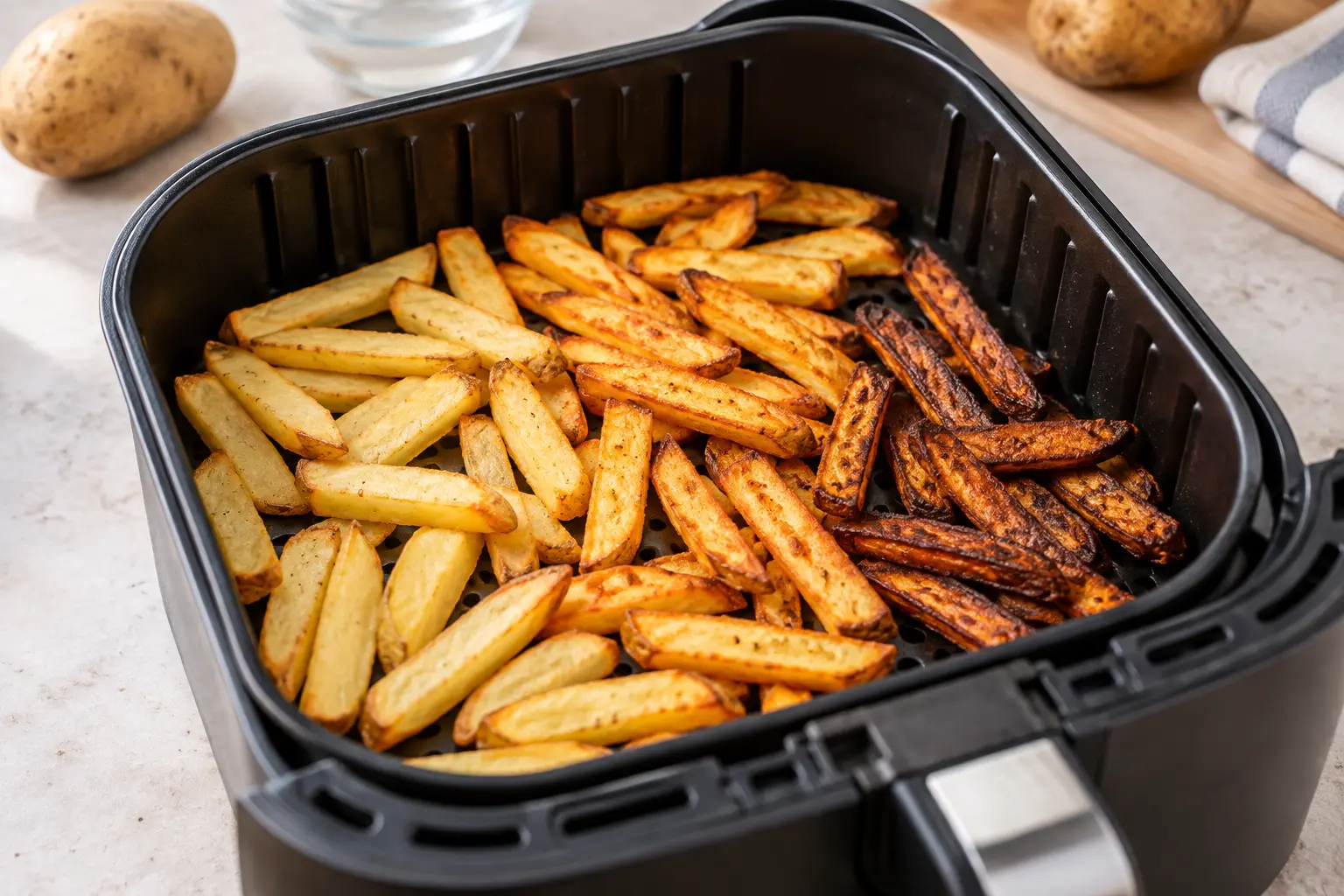
Short answer: there is no evidence that the air fryer appliance itself causes cancer. Acrylamide can form in starchy plant foods during high-temperature cooking, including air frying, but it also forms during baking, roasting and deep frying. Human studies have found no consistent evidence that dietary acrylamide increases cancer risk. Avoiding very dark browning is still a sensible exposure-reduction step.
“Air fryer cancer risk” is a frightening search phrase, but it combines two very different claims. The first is that the machine itself causes cancer; evidence does not support that. The second is that high-temperature cooking can form compounds such as acrylamide in certain foods; that is real, but the amount varies widely and the human risk is not established in the way viral headlines imply.
What is acrylamide?
Acrylamide is a chemical that can form naturally in some carbohydrate-rich plant foods when they are cooked at high temperatures. Sugars react with the amino acid asparagine during browning—the same broad Maillard chemistry that creates color and toasted flavor.
Foods in which acrylamide may occur include French fries, potato chips, roasted potatoes, toast, crackers, cookies, breakfast cereals and coffee. It is generally not the main issue in boiled foods because the surface does not become as hot and dry.
Food matters
Potato variety, sugar content and storage history can change how much acrylamide forms.
Heat matters
Higher temperatures and longer cooking generally increase formation once the surface dries and browns.
Color is useful
Dark brown areas tend to contain more acrylamide than golden yellow areas in potato products.
Method is not destiny
Air frying can produce less, similar or more acrylamide depending on the complete cooking protocol.
Does acrylamide in food cause cancer?
High experimental doses of acrylamide have caused cancer in laboratory animals. Acrylamide can be converted in the body to glycidamide, which can damage DNA. For that reason, the US National Toxicology Program considers acrylamide reasonably anticipated to be a human carcinogen.
But hazard is not the same as the risk from normal dietary exposure. The US National Cancer Institute states that a large number of case-control and cohort studies in people have found no consistent evidence that dietary acrylamide exposure is associated with the risk of any type of cancer. Measuring long-term food exposure is difficult, so research continues.
Balanced conclusion: animal evidence justifies reducing avoidable exposure, while current human evidence does not justify saying that eating air-fried food—or owning an air fryer—causes cancer.
Does an air fryer make more or less acrylamide?
There is no universal percentage. Air frying is a combination of temperature, airflow and time; deep frying is a combination of oil temperature, heat transfer and time. Change the potato, thickness, pretreatment, temperature, duration or final color and the comparison can reverse.
| Variable | Why it changes the result | What to do at home |
|---|---|---|
| Potato sugars | More reducing sugar can create more acrylamide | Do not refrigerate raw potatoes; store them cool and dark |
| Cut thickness | Thin pieces dry and brown quickly | Use even cuts and watch the smallest pieces |
| Soaking or blanching | Can remove some surface sugars | Soak raw slices 15–30 minutes, then drain and dry |
| Temperature and time | Hotter or longer cooking generally deepens browning | Use only the heat and time needed for a golden result |
| Final color | Very brown areas tend to contain more acrylamide | Stop at golden yellow or light brown |
Published experiments illustrate the variability. A 2022 potato study reported lower acrylamide with air frying than with its deep-frying comparison, with a maximum reduction of about 47% under the tested settings. Other work has found different rankings; a 2025 experiment reported the highest acrylamide in air-fried potatoes among three methods when no enzyme pretreatment was used. These are controlled food experiments, not proof of cancer outcomes in people.
The useful lesson is not to shop for one dramatic number. Control the variables you can see: storage, soaking, cut size, time, temperature and color.
How to reduce acrylamide in air fryer potatoes
FDA-aligned potato method
- Store potatoes outside the refrigerator. A cool, dark pantry or cupboard helps avoid the sugar increase associated with cold storage.
- Cut evenly. Small thin pieces can turn dark before larger pieces are ready.
- Soak raw slices for 15–30 minutes. This can reduce surface sugars that participate in acrylamide formation.
- Drain and blot dry. Drying supports even cooking and reduces splatter or steam hazards.
- Use a moderate setting. Follow the food and appliance instructions rather than defaulting to maximum heat.
- Shake or turn. Even exposure helps prevent isolated burnt edges.
- Stop at golden yellow. Remove small pieces that darken early and avoid heavily browned or blackened areas.
Does soaking potatoes remove all acrylamide?
No. Acrylamide forms during cooking; soaking is one mitigation step, not a guarantee of zero. Its effect varies with the potato and method. Do not add unverified chemicals or supplements to soaking water. Plain water for 15–30 minutes is the consumer guidance the FDA provides, followed by draining and blotting dry.
What about toast, bread and other foods?
The same color principle applies to bread: toast to light brown rather than dark brown and avoid very burnt areas. Acrylamide also exists in commercially produced foods, so home air frying is only one possible dietary source. The FDA advises a varied eating pattern rather than eliminating healthful whole-grain foods solely because acrylamide can occur.
Coffee is different: acrylamide forms when beans are roasted, not when coffee is brewed at home. Changing the air fryer setting has no relevance to that source.
Is acrylamide the same as PFAS or non-stick coating chemicals?
No. Acrylamide is formed in food during certain high-temperature cooking reactions. PFAS is a broad chemical family that includes fluoropolymers used in some non-stick coatings. PFOA is one specific PFAS associated with historical manufacturing. Mixing these terms makes it harder to assess the actual concern.
For material questions, see Air Fryer Non-Stick Coatings Explained. For the larger appliance, food-temperature and fire picture, see Are Air Fryers Safe?
Should you stop using an air fryer?
No authority cited in this guide recommends avoiding air fryers because of acrylamide. Boiling or microwaving whole potatoes produces little or no acrylamide according to FDA studies, so varying your cooking methods can reduce reliance on browned foods. When you do air fry potatoes, lighter color and sensible preparation are practical risk-reduction steps.
The bottom line
Air fryers do not cause cancer. Acrylamide can form in some air-fried starchy foods, just as it can during roasting, baking and deep frying. Animal studies establish a hazard at high experimental exposure, while human dietary studies have not found consistent evidence of increased cancer risk. Store potatoes correctly, soak raw cuts, cook only as long as necessary and choose golden over dark brown.
Official and scientific sources
- US National Cancer Institute: Acrylamide and Cancer Risk
- US FDA: Acrylamide
- US FDA: Acrylamide, diet, food storage and preparation
- PubMed: air frying, Maillard hazards and starch digestibility in French fries
- PubMed: acrylamide formation in air-fried, deep-fried and oven-fried potatoes
- PubMed: pretreatment and acrylamide in microwave-, air- and deep-fried potatoes
Evidence reviewed September 25, 2026. This guide explains population-level evidence and is not medical advice.
Frequently asked questions
Do air fryers cause cancer?
There is no evidence that the appliance itself causes cancer. Acrylamide can form in carbohydrate-rich plant foods cooked at high temperatures, including in air fryers, but human studies have not shown consistent evidence that dietary acrylamide causes cancer.
Does air frying create acrylamide?
It can. Acrylamide forms mainly in starchy plant foods when sugars and the amino acid asparagine react during high-temperature browning. It is not unique to air fryers and can also form during frying, roasting and baking.
Does an air fryer make less acrylamide than a deep fryer?
Not always. Results depend on potato variety, storage, pretreatment, oil, temperature, time and final color. Some experiments found reductions with air frying, while others did not, so there is no reliable universal percentage.
How do I reduce acrylamide in air fryer fries?
Store potatoes outside the refrigerator, soak raw slices in water for 15 to 30 minutes, drain and dry them, avoid excessive temperature and time, and stop at golden yellow rather than dark brown.
Is acrylamide in meat?
Acrylamide is mainly associated with carbohydrate-rich plant foods such as potatoes and grains. High-temperature cooking of meat raises different chemistry questions, so advice about golden fries should not be used as a complete guide to meat cooking.
Should I stop using an air fryer because of acrylamide?
No public-health authority cited here recommends avoiding air fryers for this reason. A more useful approach is to vary cooking methods, avoid heavily browned starchy foods and follow preparation steps that reduce formation.
About the Author

Clara Bennett
I write practical, model-specific air fryer reviews and comparisons. I focus on usable capacity, household fit, cleaning, materials, day-to-day ownership and value so you can choose the right appliance with fewer surprises.
Read my full profile and review method
1 thought on “Air Fryers, Acrylamide and Cancer: What the Evidence Says”