
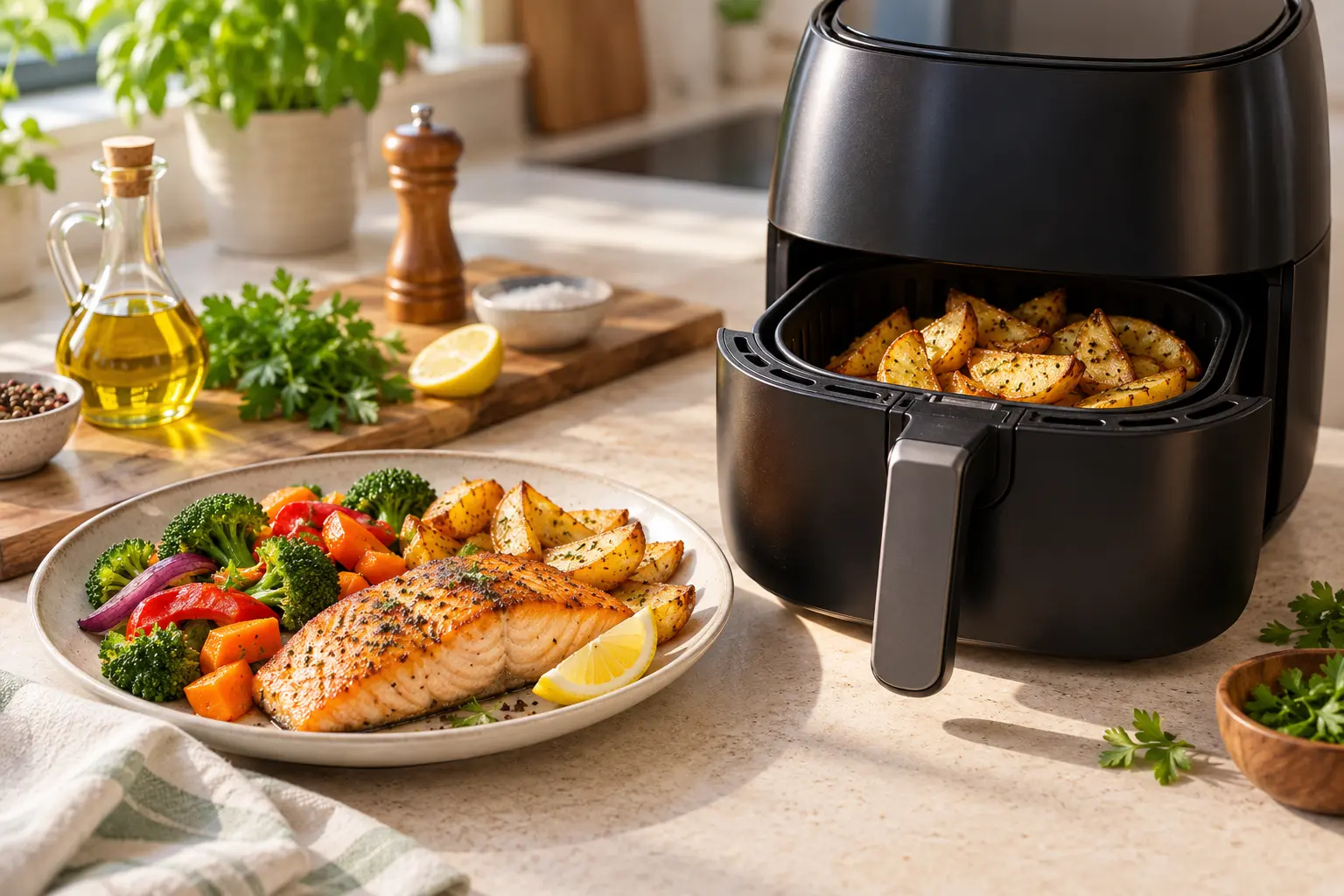
Short answer: air fryers can be a healthy cooking tool when they replace deep frying and make it easier to cook vegetables, fish, beans, lean proteins and minimally processed foods with modest added oil. They do not automatically make frozen snacks, breaded meat or oversized portions healthy. The food, oil, salt, portion and overall eating pattern determine the result.
“Are air fryers healthy?” is one of the most searched questions about the appliance, and the honest answer is more useful than a slogan. An air fryer changes the cooking method; it does not erase the nutrition label. That distinction explains why air-fried salmon and broccoli can be an excellent dinner while a basket of salty, pre-fried snacks is still an occasional food.
This guide separates the evidence-backed benefit—usually less added oil than deep frying—from claims the appliance cannot support, including automatic weight loss, guaranteed nutrient retention or “guilt-free” eating.
Why can air frying be healthier than deep frying?
A basket air fryer is essentially a small high-speed convection oven. It circulates hot air around food instead of submerging it in cooking oil. In a controlled comparison of French fries, researchers found that air-fried samples absorbed substantially less fat than deep-fried samples, although cooking took longer and texture differed.
That is the main nutritional advantage: when the food and serving size are comparable, using less oil can reduce the meal’s total fat and calories. The benefit is strongest when you start with raw or minimally processed ingredients and add a measured amount of oil. It is less predictable with frozen products that were already fried during manufacturing.
| Question | Air frying | Deep frying | Conventional baking |
|---|---|---|---|
| Cooking fat | Often a light coating or spray | Food is submerged in oil | Can use little or no added oil |
| Crisp surface | Strong airflow helps browning | Hot oil transfers heat quickly | Possible, usually slower |
| Oil absorbed | Generally lower for like-for-like fries | Usually higher | Generally low, recipe dependent |
| Health result | Depends on ingredients, oil, salt and portion | Depends on oil, food and portion | Depends on ingredients and portion |
When is air-fried food not automatically healthy?
Pre-fried frozen food
Many fries, nuggets and appetizers already contain oil, refined starch and substantial sodium before they enter your basket.
Heavy breading
A thick coating can add refined carbohydrate, sodium and calories even when you use very little spray oil.
Large portions
Using less oil does not make portion size irrelevant. A second full basket can outweigh the saving from the cooking method.
Dark browning
Very dark starchy food can contain more acrylamide. Aim for golden yellow or light brown rather than burnt.
For packaged food, compare the Nutrition Facts panel rather than relying on the words “air fryer.” Look at the serving size, calories, saturated fat, sodium, added sugars and fiber. A product advertised for air frying is not necessarily nutritionally different from the same brand’s oven product.
Are air fryer fries healthy?
Potatoes provide carbohydrate, potassium and—when the skin remains—some fiber. What changes the dish is how they are prepared. Homemade wedges tossed with a teaspoon or two of unsaturated oil and modest salt are very different from a heaped basket of thin, pre-fried frozen fries.
For a more balanced plate, keep the potato portion reasonable and add vegetables plus a protein source such as fish, chicken, tofu, beans or lentils. Thicker wedges expose less surface area to oil and browning than very thin fries. Cook them to golden yellow, not dark brown, and see our guide to air fryers, acrylamide and cancer for the preparation details.
Does air frying preserve nutrients?
There is no single answer. Heat, oxygen, water, cooking time and the food itself all influence nutrient retention. Water-soluble vitamins may be lost during boiling; some heat-sensitive compounds decline with longer cooking; and other compounds become easier to absorb after cooking. Research on vegetables shows that the “best” method can change by vegetable and nutrient.
Air frying can be quick and uses no cooking water, but it also exposes food to high heat and moving air. A 2025 study of biofortified sweet potato illustrates the trade-off: air frying preserved phenolic compounds and antioxidant capacity well in that experiment but produced the greatest beta-carotene losses among the tested methods. That is why claims that air frying always “locks in nutrients” are too broad.
Practical approach: rotate methods. Air fry or roast some vegetables, steam or microwave others, and include raw produce where appropriate. Variety is more defensible than trying to crown one appliance the universal nutrition winner.
Is air-fried chicken healthy?
It can be. Start with a lean cut, use a light coating, measure the oil and season with herbs, spices, citrus and a controlled amount of salt. Skin-on wings with a salty commercial breading have a different nutrition profile from lightly seasoned chicken breast, even if both are air fried.
Health and food safety also meet here. The USDA says all poultry should reach 165°F / 74°C in the thickest part. Crisp color is not a thermometer. Avoid overcrowding, turn pieces when needed and verify temperature before serving. The broader air fryer safety guide covers temperatures, recalls, liners and fire prevention.
Does an air fryer help with weight loss?
An air fryer does not make the body lose weight. It can be useful if it helps you replace deep-fried meals with lower-oil versions while keeping the food and portion comparable. It may also make home cooking more convenient, giving you more control over ingredients than many restaurant or takeout meals.
But compensation is easy: bigger portions, more frequent snacks, high-calorie sauces or the belief that air-fried food is unlimited can remove the advantage. If weight management is your goal, track the complete meal rather than counting the appliance as a health intervention.
What oil is healthiest in an air fryer?
Use a small measured amount of an oil you enjoy and that suits the recipe and temperature. Liquid plant oils rich in unsaturated fats—such as olive, avocado or canola oil—can fit a healthy dietary pattern. The exact “smoke point” is not the only consideration; freshness, flavor, quantity and whether the oil becomes visibly smoky matter too.
- Toss food with a measured teaspoon instead of pouring directly into the basket.
- Use a refillable mister if you want an even, light coating.
- Do not spray aerosol propellant directly onto a non-stick basket unless the manufacturer permits it.
- Stop and lower the temperature if oil or food is producing persistent smoke.
How to make air fryer meals healthier
10 choices that matter more than the marketing
- Build the meal around vegetables, beans, fish, tofu or a lean protein—not only frozen snacks.
- Measure oil instead of free-pouring it.
- Compare sodium and saturated fat on packaged-food labels.
- Choose plain frozen vegetables or potatoes more often than heavily breaded versions.
- Add flavor with herbs, spices, garlic, citrus and vinegar before reaching for more salt.
- Leave space for air to circulate so food cooks evenly without an unnecessarily long time.
- Cook starchy foods golden rather than dark brown.
- Use a food thermometer for meat, poultry, fish and leftovers.
- Pair crisp food with a high-fiber side instead of simply increasing the fried portion.
- Vary cooking methods and foods across the week.
The bottom line
Air fryers can be healthy tools, especially when they replace deep frying and make minimally processed food easier to prepare. Their advantage is mainly about what they help you do: use less added oil, cook at home and build a varied meal. They do not neutralize sodium, refined starch, saturated fat, excessive portions or heavy browning.
Sources and further reading
- Journal of Food Science via PubMed: comparison of air-fried and deep-fat-fried French fries
- PubMed: cooking methods, beta-carotene retention and antioxidant capacity in biofortified sweet potato
- USDA MyPlate: vegetables and healthy dietary patterns
- USDA FSIS: Air Fryers and Food Safety
- FDA: Acrylamide, diet, storage and food preparation
Reviewed September 25, 2026. General nutrition information only; individual medical or dietary needs should be discussed with a qualified professional.
Frequently asked questions
Are air fryers healthy for everyday use?
They can support healthy everyday cooking when they help you prepare vegetables, beans, fish, lean proteins and minimally processed foods with modest added oil. The ingredients, portions, seasoning and overall dietary pattern still matter more than the appliance.
Is air-fried food healthier than deep-fried food?
For the same food and comparable portion, air frying commonly uses much less cooking oil and can produce a lower-fat result than deep frying. That advantage may shrink when the food is pre-fried, heavily breaded or served in a larger portion.
Are air fryer fries healthy?
Potatoes can be part of a balanced diet, but the answer depends on oil, salt, portion and whether the fries were already pre-fried. Homemade wedges with modest oil and salt are nutritionally different from a large serving of highly processed frozen fries.
Does air frying destroy nutrients?
All cooking can change nutrients, and the result varies by food, nutrient, time and temperature. Air frying is not always best or worst; use the shortest time that safely cooks the food and rotate cooking methods across your diet.
Can you lose weight by using an air fryer?
An air fryer does not cause weight loss. It may help lower the energy content of meals if it replaces deep frying and you keep ingredients and portions comparable, but total intake and long-term eating habits determine the outcome.
Is air-fried chicken healthy?
It can be, especially when you choose a lean cut, use a light coating and modest oil, and serve it with vegetables or whole grains. Highly salted breading, fatty cuts and large portions change the nutritional picture. Cook poultry to 165°F or 74°C.
About the Author

Clara Bennett
I write practical, model-specific air fryer reviews and comparisons. I focus on usable capacity, household fit, cleaning, materials, day-to-day ownership and value so you can choose the right appliance with fewer surprises.
Read my full profile and review method