
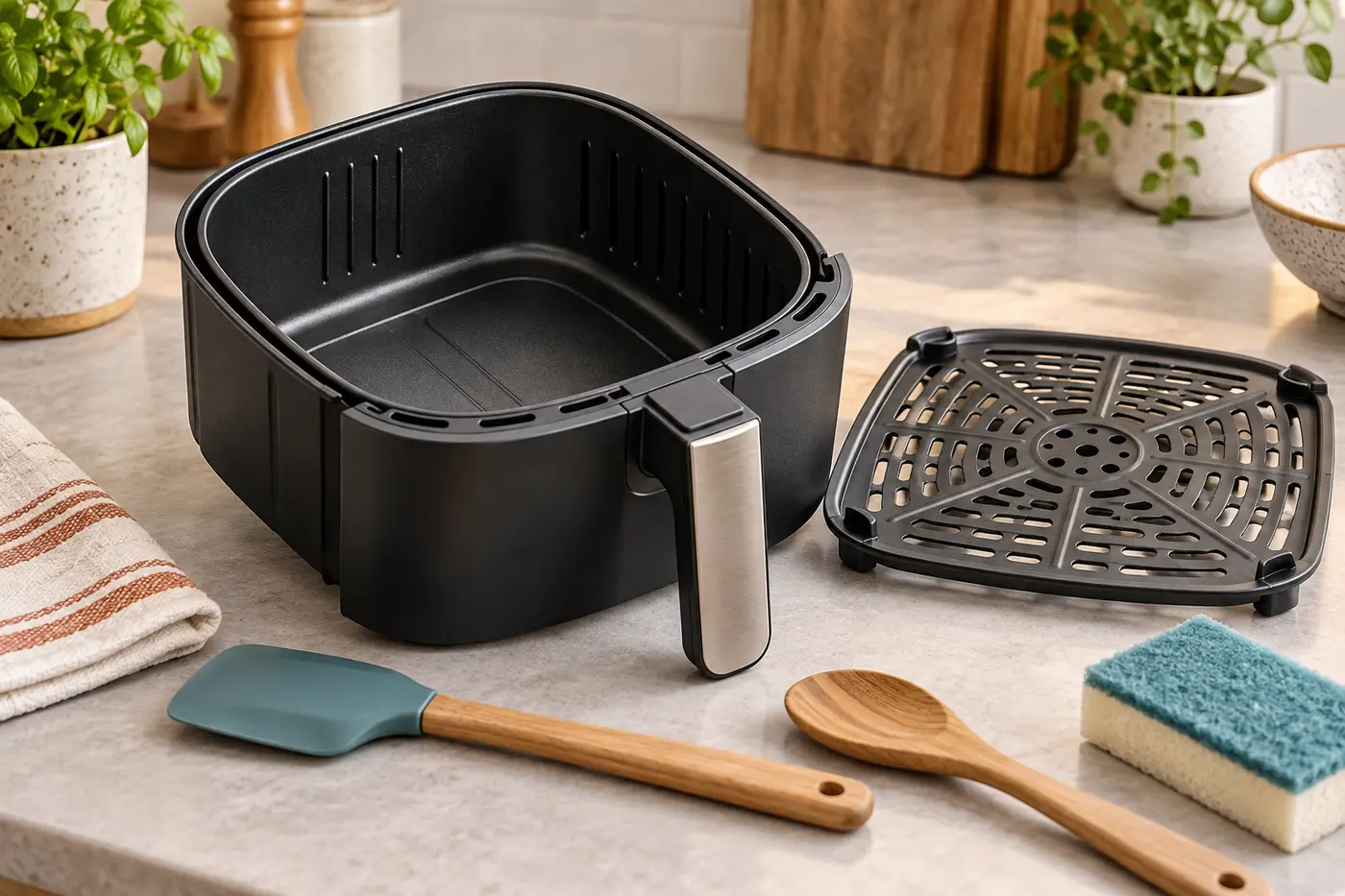
Short answer: most air fryer non-stick coatings are either PTFE-based or ceramic-style coatings applied over a metal basket. “PFOA-free” does not automatically mean “PTFE-free,” and “ceramic” does not automatically tell you the complete formulation. An intact coating used within the manufacturer’s temperature and cleaning instructions is a different situation from a basket that is peeling, bubbling or exposing bare metal.
Air fryer coating questions are no longer niche. Current YouTube searches include air fryer coating safe, air fryer coating peeling, air fryer Teflon toxic, PTFE-free air fryer, air fryer PFAS-free and stainless steel air fryer non toxic. Unfortunately, product pages often answer those concerns with a single badge instead of explaining what actually touches the food.
This guide separates the materials, the marketing terms and the practical warning signs. It is written for air fryers rather than frying pans: baskets and crisper plates are removable, exposed to fast-moving hot air, regularly scrubbed and often knocked against each other. Those details matter as much as the coating name.
What are air fryer baskets coated with?
The dark cooking basket is usually steel or aluminum underneath. The easy-release surface is added on top. The most common possibilities are:
- PTFE-based non-stick: a fluoropolymer coating chosen for low friction and easy food release. Teflon is a well-known brand name associated with PTFE; it is not the name of every PTFE formulation.
- Ceramic-style non-stick: usually a sol-gel coating built from mineral-derived ingredients over a metal base. It is a coating, not a solid ceramic basket.
- Uncoated stainless steel: no applied non-stick layer on the stated food-contact surface. It may need more oil or soaking and can release food less easily.
- Glass: some bowl-style air fryers use glass as the main cooking vessel, although racks, lids or accessories may still contain other materials.
- Mixed construction: the basket, crisper plate, rack and baking accessory can each use a different material. A claim about one component should not be assumed to cover all of them.
There is no reliable coating identification test you can perform by looking at a black basket. If the manufacturer only says “non-stick,” ask for the material used on the basket and the removable crisper plate for the exact model number and market.
| Surface | Main advantage | Main trade-off | Label to verify |
|---|---|---|---|
| PTFE-based coating | Strong food release and easy cleaning | Can be damaged by abrasion; fluoropolymer/PFAS concerns matter to some buyers | PTFE used or PTFE-free; maximum temperature; replacement basket availability |
| Ceramic-style coating | Often marketed without PTFE and sometimes without PFAS | Release performance may change with wear; formulations differ | Explicit PTFE-free or PFAS-free statement for every food-contact part |
| Uncoated stainless steel | No applied non-stick coating on the stated surface | Food can stick more readily; fewer basket-style choices | “Uncoated” stainless steel, not merely a stainless outer housing |
| Glass bowl | Visible, coating-free main vessel when genuinely bare glass | Heavier; racks and accessories still need checking | Materials for bowl, rack, lid and any crisper insert |
PTFE, Teflon, PFOA and PFAS: what is the difference?
These terms are often collapsed into one frightening word cloud, but they are not interchangeable.
PTFE is polytetrafluoroethylene, a large fluoropolymer used to create a slippery, heat-resistant surface. Teflon is a trade name associated with fluoropolymer products; saying “no Teflon” is not as precise as asking whether the food-contact surface contains PTFE or another fluoropolymer.
PFOA is a much smaller PFAS chemical that was historically used as a processing aid in the manufacture of some fluoropolymers. It is not the coating itself. The US Environmental Protection Agency reports that participating companies phased out domestic manufacture and import of PFOA through its stewardship program. That history explains why “PFOA-free” is now common on packaging—but the claim tells you nothing definite about whether the finished basket contains PTFE.
PFAS is a broad family containing thousands of substances. PTFE is generally included in broad scientific and regulatory definitions of PFAS, but its physical behavior is not identical to smaller PFAS such as PFOA. “Contains a fluoropolymer” and “exposure to a mobile PFAS” are not automatically the same claim.
The label trap: a PFOA-free air fryer may still have a PTFE coating. If avoiding fluoropolymers is your goal, look for an explicit PTFE-free or, more broadly, PFAS-free statement tied to the exact basket, plate and accessories.
Is an air fryer non-stick coating safe?
A responsible answer needs conditions. The coating should be intact, the appliance should be used as instructed, and the basket should not be overheated or abused with abrasive tools.
The US Food and Drug Administration explains that authorized fluoropolymer non-stick coatings are polymerized and tightly bound to cookware, with studies showing negligible amounts of PFAS capable of migrating to food from that coating. Germany’s Federal Institute for Risk Assessment similarly says adverse health effects are not expected from PTFE-coated cookware when it is used as intended.
That does not make every temperature or every damaged surface acceptable. Health Canada advises against using non-stick cookware or bakeware over 260°C (500°F), against heating it empty and in favor of kitchen ventilation. Your air fryer’s own manual remains the controlling instruction because maximum settings and preheat behavior vary by model.
So the useful question is not simply “Is PTFE toxic?” It is:
- What coating is used on this exact model?
- Is every food-contact part still intact?
- Am I staying within the stated cooking range?
- Am I cleaning it in a way the manufacturer permits?
- Can I buy a genuine replacement basket if the surface fails?
Air fryer coating peeling: should you stop using it?
Yes—if the basket is visibly peeling, flaking, bubbling or exposing the base metal, stop using that component and contact the manufacturer. This is not a claim that one swallowed speck will cause poisoning. It is the practical response to a food-contact surface that is no longer in its intended condition.
Not every mark is peeling. Light-colored scuffs can be baked-on residue or contact marks from inserting the basket. Clean the cold part with warm water, mild dish soap and a soft sponge. If a raised edge, loose film, blister or widening bare patch remains, photograph it and request a replacement basket or warranty assessment.
Do not sand, repaint or cover a failed coating. A paper or silicone liner does not repair the surface and can change airflow if it blocks holes. Replacement is the clean solution.
Replace or escalate the basket when you see:
- Loose flakes or a coating edge that lifts under gentle washing
- Bubbles, blisters or widespread rough patches
- Base metal visible across a growing area
- Rust or corrosion where a steel base has been exposed
- A manufacturer recall or model-specific safety notice
Why does an air fryer coating peel?
The usual causes are mechanical damage and unsuitable cleaning rather than normal hot-air circulation. Common contributors include:
- Metal tongs, forks or knives scraping the basket
- Steel wool, scouring powders, hard brushes or abrasive dishwasher detergents
- Forcing the crisper plate in at an angle so its feet grind against the basket
- Stacking loose accessories inside the basket during storage
- Thermal shock from running cold water over a very hot basket
- Repeated overheating or operating outside the manual’s instructions
- A manufacturing defect or poor bond between coating and base metal
Philips, for example, tells owners not to use metal utensils or abrasive cleaning materials because they can damage the non-stick coating. That advice is broadly sensible, but the exact cleaning and dishwasher instructions for your model take priority.
Are ceramic-coated air fryers better?
Ceramic-style coatings are a genuine alternative, particularly for buyers searching for a PTFE-free air fryer. Several manufacturers now identify specific baskets as ceramic-coated and PTFE-free or PFAS-free. The advantage is a clear route away from fluoropolymer coatings when that is your purchasing priority.
However, “ceramic” is not a lifetime guarantee and not a complete chemical disclosure. Most ceramic non-stick baskets are metal underneath with a sol-gel surface. Their release performance can decline as the surface wears or accumulates residue. Different formulations have different binders, pigments and durability.
Use three checks:
- Look for the exact phrase PTFE-free or PFAS-free—not only “ceramic.”
- Confirm the claim applies to both basket and crisper plate.
- Check whether a replacement part is sold for your exact regional model.
A ceramic coating that has begun to chip or expose metal should be treated the same way as a failed PTFE-based coating: stop, document and replace the affected part.
How to find a PTFE-free or PFAS-free air fryer
Search results for “non-toxic air fryer” mix together several different goals. Decide which one you mean before comparing products:
- No PTFE: choose a model whose exact food-contact surfaces are explicitly identified as PTFE-free.
- No intentionally added PFAS: look for a broader PFAS-free statement, ideally backed by material documentation rather than a retailer bullet point.
- No applied non-stick coating: prioritize verified uncoated stainless-steel or glass cooking surfaces.
- Minimal plastic near food: inspect the complete cooking chamber, not only the outer housing description.
Be especially careful with regional variants. A US model and a similarly named European or Asian model can use different baskets, capacities or suppliers. Verify the full model code rather than relying on the family name.
Five questions to ask before buying
- What are the basket and crisper plate made from?
- Does “PFOA-free” hide the continued use of PTFE?
- Does a PFAS-free claim cover every food-contact accessory?
- What is the maximum stated cooking temperature?
- Are genuine replacement food-contact parts available?
How to protect an air fryer non-stick coating
- Use silicone or wooden utensils. Keep metal forks, tongs and knives away from the basket.
- Let the basket cool. Avoid sudden cold-water contact while the metal is still very hot.
- Soak instead of scrape. Warm water, mild detergent and time are safer than force.
- Choose a soft sponge. Avoid steel wool, abrasive powders and hard-edged tools.
- Check the manual before using a dishwasher. “Dishwasher-safe” varies by component and does not always mean dishwasher cleaning is best for coating life.
- Insert the crisper plate gently. Make sure feet and rubber bumpers are present and aligned.
- Store accessories separately. Do not let racks and skewers grind against the basket.
- Inspect during cleaning. Good light makes lifting edges, corrosion and worn spots easier to detect early.
What is the best coating choice?
There is no honest universal winner. PTFE-based coatings usually offer excellent release and straightforward cleaning. Verified ceramic coatings address the demand for PTFE-free or PFAS-free food-contact surfaces. Uncoated stainless steel and glass avoid an applied non-stick layer but introduce different cooking, cleaning, weight and product-choice trade-offs.
For most buyers, transparency is more valuable than a fashionable material label. Prefer a manufacturer that identifies the exact food-contact materials, gives clear temperature and cleaning instructions, sells replacement parts and avoids vague claims such as “healthy coating” without a definition.
Frequently asked questions
What is an air fryer non-stick coating made of?
Most coated baskets use either a PTFE-based fluoropolymer coating or a ceramic-style sol-gel coating over steel or aluminum. The exact formulation varies, so check documentation for the exact model.
Is PFOA-free the same as PTFE-free?
No. PFOA is a different chemical historically used as a processing aid. PTFE is the finished fluoropolymer commonly used for non-stick performance. A basket can be PFOA-free and still contain PTFE.
Should I use an air fryer if the coating is peeling?
Stop using the affected basket or tray until the manufacturer has assessed it. Peeling, bubbling, flaking or exposed base metal means the food-contact surface is no longer in its intended condition.
Are ceramic-coated air fryers PTFE-free?
Many are, but ceramic wording alone is not proof. Look for an explicit PTFE-free or PFAS-free statement covering the exact basket and crisper plate.
What is the safest air fryer basket material?
There is no universal winner. An intact coating used according to its manual can be suitable. If your goal is to avoid an applied coating, prioritize verified uncoated stainless-steel or glass food-contact surfaces and check every accessory.
How do I stop an air fryer coating from peeling?
Use silicone or wooden tools, avoid metal utensils and abrasive scrubbers, let the basket cool before washing, follow the manual for dishwasher use and stay within the manufacturer’s temperature instructions.
Official sources used
This article was checked against current official guidance on September 25, 2026. Product formulations and regulations can change, so verify your exact model and country.
- US Food and Drug Administration: Questions and Answers on PFAS in Food
- Health Canada: The safe use of cookware and bakeware
- US Environmental Protection Agency: PFOA Stewardship Program
- German Federal Institute for Risk Assessment: PTFE-coated cookware questions and answers
About the Author

Clara Bennett
I write practical, model-specific air fryer reviews and comparisons. I focus on usable capacity, household fit, cleaning, materials, day-to-day ownership and value so you can choose the right appliance with fewer surprises.
Read my full profile and review method
3 thoughts on “Air Fryer Non-Stick Coatings Explained: PTFE, PFAS & Ceramic”