
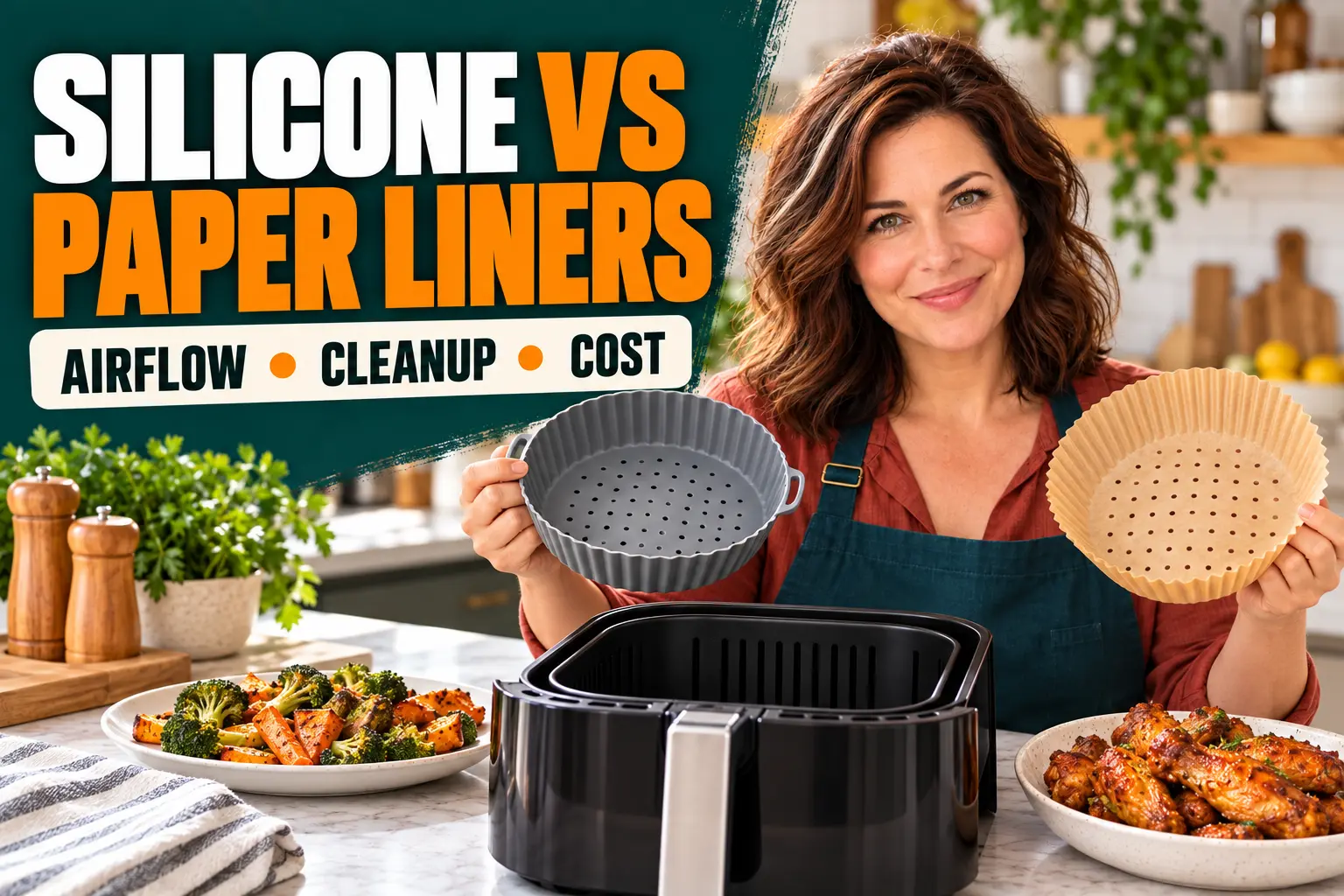
Quick answer: Silicone liners are reusable, stable and good for saucy food but can reduce direct airflow and need washing. Paper liners are convenient for greasy or sticky food but are single-use, can curl, and must never be placed loose in a running air fryer; food must weigh them down and the manual must allow them.
A liner is a cleanup accessory, not an automatic cooking upgrade. Covering perforations changes how air reaches the underside of food, so a cleaner drawer can come with softer bases, longer cooking or more turning.
The best choice depends on the food. Use no liner when maximum crisping matters, a fitted silicone liner for messy reusable cooking, or properly sized perforated parchment when quick cleanup matters and enough food can secure it.
Best for crisping
No liner, or a perforated liner that leaves much of the basket base open.
Best for reuse
A temperature-rated silicone liner that fits without folding into the food or heater zone.
Best for convenience
A model-compatible paper liner placed only after food is ready to weigh it down.
Biggest hazard
Running the fan with an empty or lightly loaded paper liner that can lift into the heating element.
How to choose and use an air fryer liner
- Check whether the manual permits liners. Some designs restrict foil or paper because of heater position, airflow or grease routing.
- Measure the flat basket base. Choose a liner that sits inside the base without climbing toward the heater or blocking the drawer from closing.
- Check the temperature rating. The liner rating must exceed the cooking temperature. Unknown paper, wax paper and ordinary silicone mats are not substitutes.
- Match the liner to the food. Use open airflow for fries and breaded food; use a shallow silicone tray for sticky marinades or baked mixtures.
- Add paper only with food. Never place an empty paper liner in during preheating. Put enough food across it to resist the fan.
- Keep edges below the food line. Trim only if the product and manual allow it, and never leave corners standing near the heater.
- Turn food and inspect the base. A solid liner traps steam and fat. Turn food more often and remove pooled grease safely after cooling.
- Clean or discard after use. Wash silicone promptly so grease does not polymerize; discard scorched, torn or heavily saturated paper.
Silicone versus paper liners
Neither option wins every category.
| Factor | Silicone liner | Paper liner | No liner |
|---|---|---|---|
| Airflow | Reduced if base is solid | Varies; perforated paper performs better | Maximum through the basket |
| Cleanup | Contains drips but must be washed | Quick disposal after cooling | Basket needs direct cleaning |
| Stability | Usually stable when fitted | Must be weighted by food | Not applicable |
| Crisping underneath | Often softer unless ridged/perforated | Can be softer with solid paper | Usually best |
| Cost over time | Higher upfront, reusable | Low per piece, recurring cost | No accessory cost |
| Best use | Sticky, saucy or baked dishes | Moderately greasy or sticky food | Fries, wings and foods needing maximum airflow |
Are silicone air fryer liners safe?
Use a reputable food-contact silicone product with a clear temperature rating and no cracking, tackiness or persistent odor. The liner should sit flat and remain well below the heater. Silicone can be safe at its rated temperature, but a vague marketplace listing is not a substitute for material and care information.
Are disposable paper liners the same as parchment?
Air fryer paper liners are generally heat-resistant parchment shapes, sometimes perforated or formed like a shallow bowl. Wax paper, paper towels and ordinary printed paper are not equivalents. Stay below the package temperature limit and discard any liner that chars or becomes brittle.
Do liners make air fryer food less crispy?
A solid base interrupts direct airflow and holds moisture under food, so the underside may brown more slowly. Perforations, a smaller footprint, turning food and avoiding overcrowding reduce the effect. For the crispest fries or breading, cook directly on the clean basket.
Stop and unplug: Switch off and unplug if paper lifts, curls toward the heater, chars, or if silicone warps, melts or produces a persistent chemical odor. Do not reach into a running appliance to grab a moving liner.
Safe liner checklist
- Manual permits the liner type
- Correct shape and size for the basket
- Temperature rating above the cooking setting
- Paper completely secured by food
- Edges remain below the heater zone
- Airflow not unnecessarily blocked
- Pooled grease removed after cooling
Related guides
- What Can You Put in an Air Fryer?
- Air-Fryer-Safe Containers and Utensils
- Air Fryer Accessories and Parts
- How to Clean an Air Fryer
Sources and further reading
Reviewed September 25, 2026. Always follow the use-and-care manual for your exact model; controls, removable parts, clearances and error codes are not standardized.
Frequently asked questions
Are silicone or paper air fryer liners better?
Silicone is reusable and stable; paper is convenient and disposable. For maximum underside crisping, no liner or a well-perforated liner is usually better.
Can you preheat an air fryer with a paper liner?
Do not preheat with loose paper. The fan can lift it into the heating element. Add an approved liner only when enough food is ready to secure it.
Do silicone liners block air fryer airflow?
Solid silicone bases reduce direct airflow from below. Ridged or perforated designs, adequate side clearance and turning food can reduce the impact.
Can you reuse paper air fryer liners?
Treat disposable liners as single-use when greasy, wet, scorched or fragile. Reusing them can make tearing and lifting more likely.
Can I use wax paper in an air fryer?
No. Wax paper is not a substitute for heat-rated parchment and its coating can melt or smoke.
About the Author

Clara Bennett
I write practical, model-specific air fryer reviews and comparisons. I focus on usable capacity, household fit, cleaning, materials, day-to-day ownership and value so you can choose the right appliance with fewer surprises.
Read my full profile and review method