
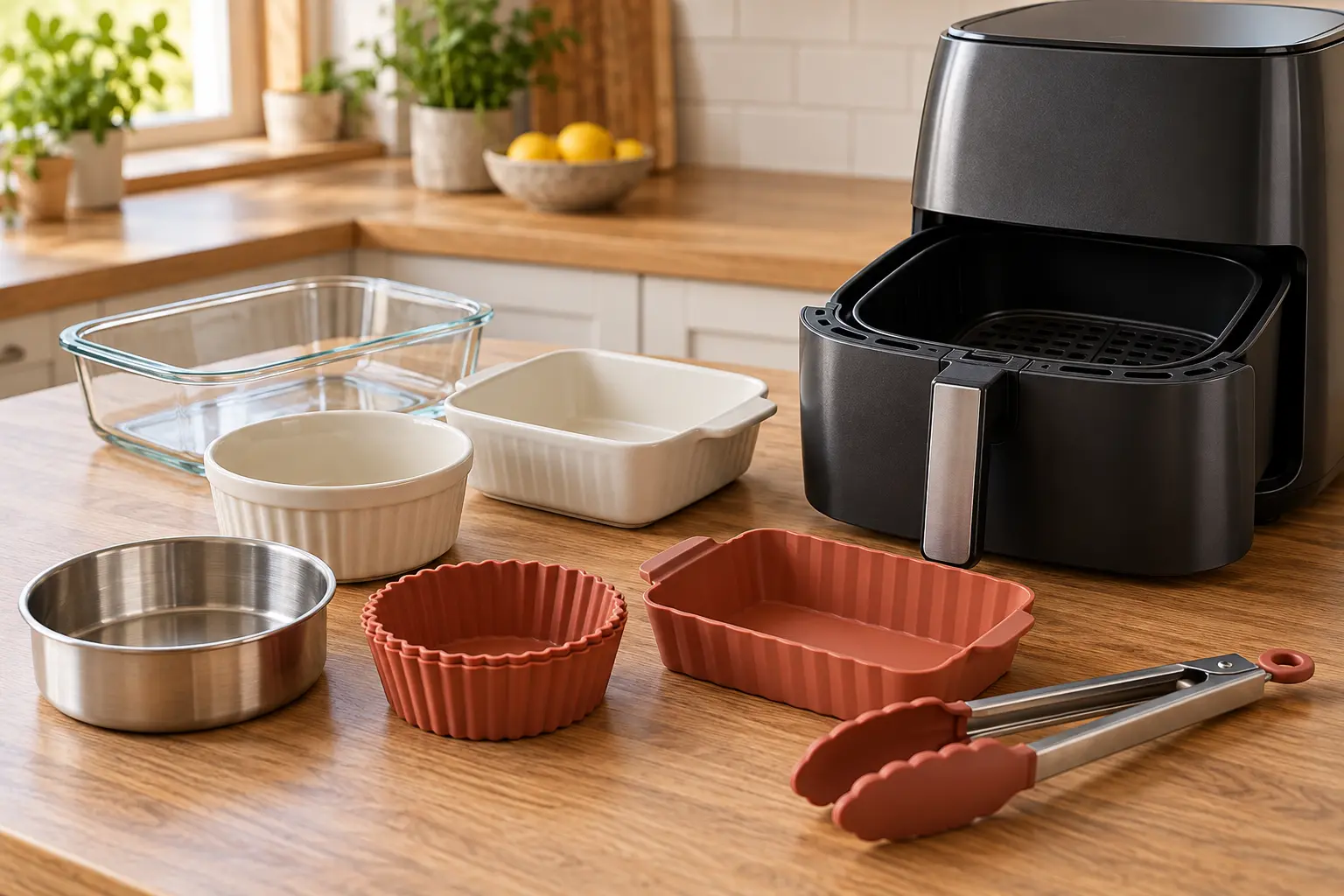
Short answer: use only containers explicitly rated for oven heat and allowed by your air fryer’s manual. Oven-safe glass, ceramic, metal and food-grade silicone can work when they fit inside the basket, remain below the heating element and leave room for airflow. Microwave-safe alone is not enough. Ordinary plastic, wax paper, paper plates and sealed containers should stay out.
“What containers can you use in an air fryer?” has a simple first test: treat the appliance like a compact, powerful convection oven—not like a microwave. Then apply three more checks: the material’s temperature rating, the manufacturer’s model-specific rules, and whether the container leaves enough space for hot air to circulate.
Which containers are air-fryer-safe?
| Material | Can it go in an air fryer? | Main precautions |
|---|---|---|
| Oven-safe glass | Usually, if the manual permits it | Must be explicitly oven-safe; avoid chips and thermal shock; leave airflow space |
| Oven-safe ceramic or stoneware | Usually | No cracks or unknown decorative finish; check temperature rating and fit |
| Stainless steel | Usually | Use an oven-safe shape; handles become hot; do not block the basket |
| Aluminum pan | Often | Check the manual; secure light pans; acidic food can react with bare aluminum |
| Food-grade silicone | Usually, within its heat rating | Choose stable oven-safe silicone; keep it away from the element |
| Parchment liner | Model-dependent | Use only if permitted, below its heat rating and weighted down by food |
| Aluminum foil | Model-dependent | Some brands advise against it; never leave it loose or block airflow |
| Ordinary plastic or takeout tub | No | Can soften, warp or melt; microwave-safe is not an oven rating |
| Wax paper, paper plate or cardboard | No | Can scorch, ignite, shed coatings or lift toward the heater |
Philips says ovenproof dishes or molds made from glass, ceramic, metal or silicone can be used in its Airfryers, while also requiring space around the dish for airflow and placement inside the basket rather than directly in the lower pan. Your brand or model may differ, so its manual has the final word.
Can you put glass in an air fryer?
Yes—if the dish is explicitly labeled oven-safe, fits securely and your air fryer manual allows it. “Glass” alone is not a heat rating. A refrigerator container, drinking glass or decorative bowl may not be designed for rapid dry heat.
- Inspect for chips, hairline cracks and damaged rims.
- Avoid sudden temperature changes: do not put cold glass straight into a fully heated basket unless the manufacturer explicitly allows it.
- Do not set a very hot glass dish on a wet, cold or conductive surface; follow its handling instructions.
- Leave clearance around the sides and above the dish.
- Use dry oven mitts and support the base when removing it.
A brand name such as Pyrex is not a substitute for reading the markings and instructions on that exact piece, especially because products and formulations vary by market and age.
Can you put ceramic in an air fryer?
Oven-safe ceramic ramekins and baking dishes are often suitable. Avoid pieces with cracks, repaired handles or purely decorative finishes that are not approved for food and oven use. Thick stoneware takes time to heat, so the food may need a different cooking time than it would in the open basket.
Do not confuse a ceramic-style non-stick coating with a solid ceramic baking dish. The coating is a thin surface applied to metal; the dish is a separate vessel with its own temperature and thermal-shock limits.
Can you put metal in an air fryer?
Unlike a microwave, an air fryer heats with an electric element and circulating air, so oven-safe metal pans, racks and skewers are commonly used. Stainless steel and purpose-made aluminum accessories are practical choices when they fit.
Remove plastic lids, rubber bands and non-oven-safe handles. Make sure no tall skewer, handle or foil edge can touch the heating element. Metal becomes extremely hot even when it does not look hot.
Can you put aluminum foil in an air fryer?
Check the manual because manufacturer advice genuinely differs. Philips advises against baking paper and foil in many of its basket models because covering the base reduces airflow, and a loose sheet can be pulled into the heating element and burn. Other manufacturers permit a small secured piece.
If—and only if—your manual permits foil:
- use the smallest piece needed;
- place it in the permitted basket or tray position, never loose in the appliance body;
- put food on top before the fan starts so the foil cannot lift;
- keep openings needed for airflow uncovered;
- keep foil below and away from the heating element;
- avoid prolonged contact with strongly acidic or salty food unless the cookware guidance permits it.
Can you use parchment paper or an air fryer liner?
Purpose-made parchment can be useful for sticky food, but paper is combustible. Never preheat an empty basket with a loose liner. Use food to hold it down, stay below the liner’s temperature rating and keep it clear of the element. Perforated paper can preserve more airflow than a solid sheet, but it is still subject to the manual.
Wax paper is not parchment. Its coating can melt or smoke, so it does not belong in an air fryer. A paper plate, paper towel or ordinary printed paper is also unsuitable.
Can silicone go in an air fryer?
Food-grade silicone bakeware can work well if it is explicitly oven-safe above the selected temperature. A stable ramekin, muffin cup or liner should not collapse into the food or lift toward the heater.
Cheap or undocumented silicone can have an unclear composition or rating. Replace silicone that becomes sticky, chalky, cracked, torn or permanently distorted. Remember that a deep solid liner can reduce browning by blocking airflow under the food.
What utensils should you use?
| Utensil | Best use | Caution |
|---|---|---|
| Silicone-tipped tongs | Turning food without gouging a coating | Check the heat rating; keep handles away from the heater |
| Wood or bamboo tools | Gentle lifting and stirring | Do not leave them inside while cooking unless designed for that use |
| Heat-rated nylon | Short contact with food and coated baskets | Do not exceed its temperature limit or rest it on a hot element |
| Metal tongs or spatula | Bare stainless-steel racks or pans | Can scratch PTFE or ceramic-style coatings |
| Instant-read thermometer | Verifying safe internal food temperature | Do not leave a non-oven-safe probe in the appliance |
Why fit and airflow matter
A material can be oven-safe and still be the wrong accessory for your air fryer. A dish that fills the basket edge to edge prevents air from reaching the sides and underside of the food. That can produce pale bottoms, longer cooking and uneven temperatures.
Philips advises placing a baking dish in the basket, not directly in the lower pan, and leaving space on both sides for airflow. Keep the top of the container comfortably below the heating element and any stated maximum height. Measure the inside basket dimensions rather than relying on the advertised quart capacity.
Important: “microwave-safe,” “dishwasher-safe” and “freezer-safe” do not mean “oven-safe.” Look for an oven temperature rating that exceeds your chosen air fryer setting.
Containers that should not go in an air fryer
- ordinary plastic storage containers, yogurt cups and takeout tubs;
- plastic wrap or plastic lids;
- melamine tableware unless explicitly approved for oven use, which is uncommon;
- wax paper, paper plates, paper towels and lightweight cardboard;
- sealed jars or containers that can build pressure;
- cracked, chipped or repaired glass and ceramic;
- wooden serving bowls and utensils left inside for the full cook;
- anything with an unknown coating, adhesive, paint or temperature limit.
How to choose the right air fryer accessory
- Read the accessory section of the exact air fryer manual.
- Confirm “oven-safe” and the maximum temperature on the container maker’s instructions.
- Measure basket width, length, corner radius and usable height.
- Leave a clear path for air around the sides and, when required, underneath.
- Choose a stable shape that cannot tip, fly up or contact the element.
- Remove every lid or handle not rated for oven heat.
- Use dry oven mitts and a heat-resistant landing surface.
- Adjust time cautiously because food in a dish cooks differently from food spread in the basket.
Also inspect the basket itself. If its food-contact surface is damaged, read our non-stick coatings guide. For liner, fire and food-temperature rules, see Are Air Fryers Safe?
The bottom line
The safest air fryer container is not simply “glass” or “silicone.” It is a food-contact vessel that is explicitly oven-safe at the selected temperature, permitted by the appliance manual, undamaged, stable and small enough to preserve airflow. When any one of those checks fails, use a different container.
Official sources used
- Philips Support: ovenproof glass, ceramic, metal and silicone baking dishes
- Philips Support: baking paper, foil and airflow
- USDA FSIS: Air Fryers and Food Safety
- US FDA: food-contact substances and cookware
Reviewed September 25, 2026. Always follow the instructions for your exact air fryer and accessory; model-specific rules take priority.
Frequently asked questions
What containers can you use in an air fryer?
Use a container explicitly rated for oven heat and within its stated temperature limit. Depending on the model, suitable choices can include oven-safe glass, ceramic, stainless steel, aluminum and food-grade silicone, provided air can circulate around them.
Can you put glass in an air fryer?
Only use glassware explicitly marked oven-safe and permitted by your air fryer manual. Avoid chipped glass and sudden temperature changes, such as moving a refrigerated dish directly into a hot basket.
Can you put aluminum foil in an air fryer?
Manufacturer rules differ. If your manual permits foil, keep it secured under food, away from the heating element and clear of essential airflow. Some manufacturers, including Philips for many models, advise against it.
Can you put silicone in an air fryer?
Food-grade oven-safe silicone can be suitable when its heat rating exceeds the selected temperature. Use a stable size that cannot lift into the element and replace it if it becomes sticky, cracked or distorted.
Can you put a plastic container in an air fryer?
Do not use ordinary food-storage, takeout or microwave-only plastic. Air fryers operate like compact convection ovens, and plastic that is not specifically designed and rated for that heat can soften, melt or release unwanted substances.
Does microwave-safe mean air-fryer-safe?
No. Microwave-safe describes a different heating environment. A container also needs an explicit oven-safe temperature rating and must comply with the air fryer manufacturer’s size, placement and airflow instructions.
Can you put a paper plate or wax paper in an air fryer?
No. Paper plates, wax paper and ordinary paper can scorch, melt coatings or lift into the heating element. Use only purpose-made parchment if the manual permits it, and always keep it weighted down by food.
About the Author

Clara Bennett
I write practical, model-specific air fryer reviews and comparisons. I focus on usable capacity, household fit, cleaning, materials, day-to-day ownership and value so you can choose the right appliance with fewer surprises.
Read my full profile and review method