
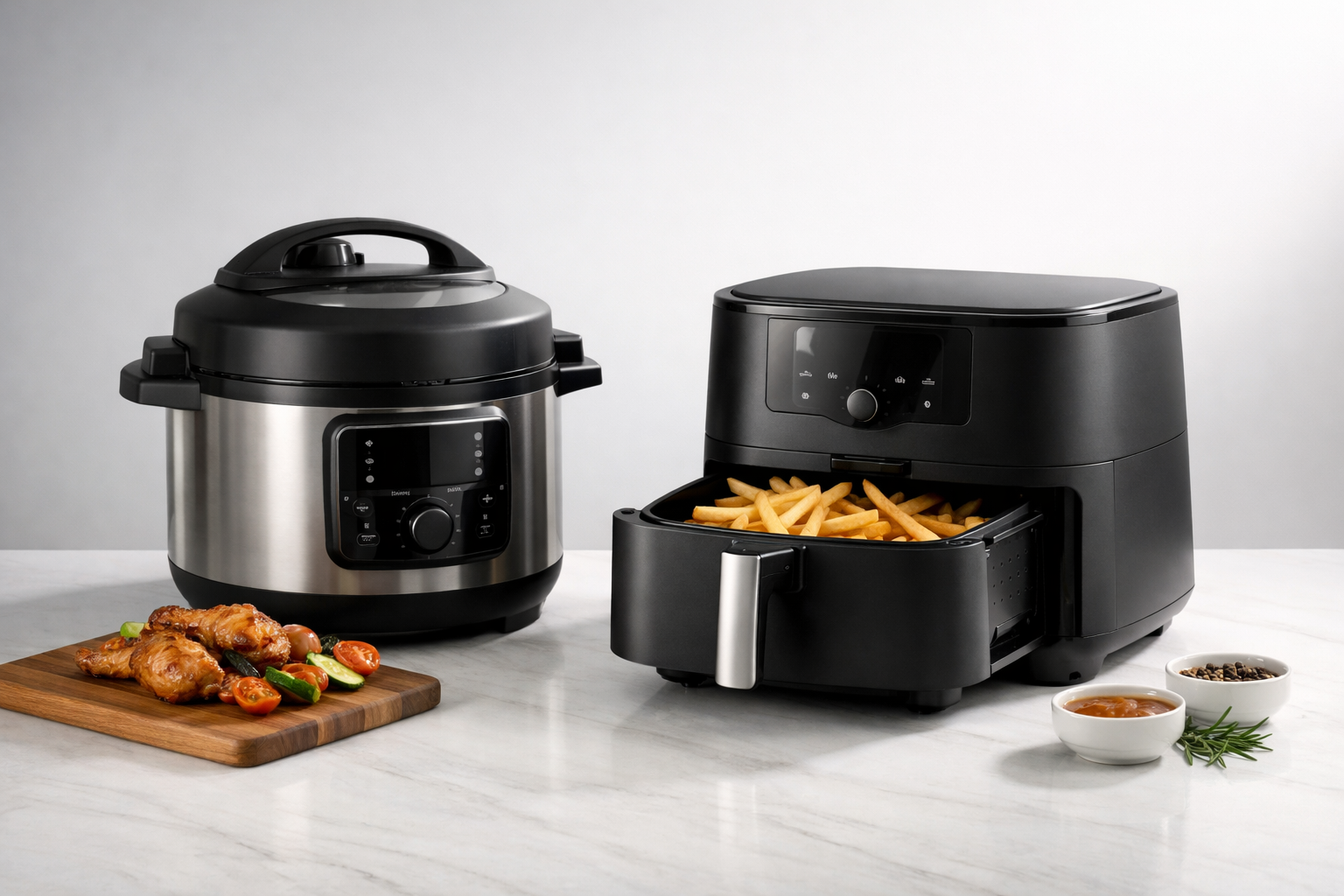
Short answer: the best multi-cooker air fryer combo depends on what “multi-cooker” means for your meals. Choose a pressure-cooking model if you want beans, stews and tender meat before crisping; a steam-and-air-fry oven if you want complete tray meals; a stirring model for risotto, curries and chips; or a grill-and-slow-cook pot if pressure cooking is unnecessary.
This is a specification-led comparison based on current manufacturer pages and manuals checked on 22 October 2026. It is not a hands-on test, and availability varies by country.
- What counts as a multi-cooker air fryer combo?
- Four verified combo architectures compared
- Best for pressure cooking and crisping: Instant Pot Duo Crisp
- Best for steam-and-crisp tray meals: Ninja Combi SFP701C
- Best for automatic stirring: Tefal Multicook Actifry MY741C40
- Best for grilling, searing and slow cooking: Russell Hobbs 26520
- Which type fits your cooking?
- Capacity: compare usable area, not only litres
- Counter space, lid clearance and storage
- Electrical and regional checks
- Cleaning and long-term ownership
- Used-buying checklist
- Frequently asked questions
- Is every multi-function air fryer a multi-cooker?
- Can a combo replace a dedicated air fryer?
- Is a steam-and-air cooker the same as a pressure cooker?
- Do litre and quart ratings show how much food I can air fry?
- Which combo is easiest to store?
- Final verdict
- Official sources
What counts as a multi-cooker air fryer combo?
A genuine combo must do more than give an ordinary air fryer several dry-heat presets. Air fry, roast, bake and reheat all use closely related hot-air cooking. A multi-cooker combo adds a materially different cooking method such as pressure cooking, steaming, slow cooking, searing, stirring or rice cooking.
That distinction removes several misleading entries from the previous version of this guide. The Instant Vortex Plus and Ninja AF300 are capable air fryers, but they are not pressure multi-cookers. A small BLACK+DECKER basket fryer is not a multi-cooker either. Counting every preset as a separate appliance function makes comparisons look impressive without telling you what the machine can actually do.
Four verified combo architectures compared
| Model | Capacity | Distinct cooking system | Pressure cooks? | Published electrical specification |
|---|---|---|---|---|
| Instant Pot Duo Crisp with Ultimate Lid 6.5QT | 6.5 US qt | Pressure cooking plus top-down air frying under one lid | Yes | 1,500 W; 120 V, 60 Hz |
| Ninja Combi SFP701C | Family-size Combi pan | Steam and rapid air circulation in an oven-style chamber | No | Use the rating label for the exact regional unit |
| Tefal Multicook Actifry MY741C40 | 6 L bowl | Stirring paddle, multi-layer tray and hot-air cooking | No | 1,334 W; 220–240 V, 50–60 Hz |
| Russell Hobbs Satisfry 26520 | 5.5 L pot | Air fry, grill, roast, sear, bake and slow cook | No | 1,745 W; buy the correct regional version |
These are not four interchangeable products. Their shapes, wet-cooking abilities and accessory systems change what you can cook efficiently. Capacity figures also describe different containers: a deep pressure-cooker pot is not equivalent to a wide air-fry tray.
Best for pressure cooking and crisping: Instant Pot Duo Crisp
The current Instant Pot comparison chart lists the Duo Crisp with Ultimate Lid at 6.5 quarts and 13 functions: pressure cook, air fry, roast, broil, bake, dehydrate, proof, slow cook, sauté, steam, sous vide, yogurt and keep warm. The key advantage is not the function count. It is the ability to pressure-cook a moist dish and then brown its surface without moving the food to a second appliance.
The Ultimate Lid design differs from the older 6-quart Duo Crisp, which uses two interchangeable lids. The older version remains documented by Instant Pot and offers 11 functions, but storing the unused lid is a real space consideration. Check the full product name before buying accessories or a replacement inner pot: “Duo Crisp + Air Fryer 6QT” and “Duo Crisp with Ultimate Lid 6.5QT” are not the same model.
Choose it when: pressure-cooked beans, stock, stews, ribs or large cuts are central to your cooking, and you also want a browned finish.
Think twice when: you mainly cook chips, wings or breaded foods. A wide dedicated basket can spread food more effectively and is simpler to load. The US Instant Pot pages specify 120 V/60 Hz, so those exact units are not suitable for direct use on a 230 V European supply.
Best for steam-and-crisp tray meals: Ninja Combi SFP701C
The Ninja Combi is closer to a compact oven than a pressure-cooker pot. Ninja documents 14 modes: Combi Meals, Combi Crisp, Combi Bake, Rice/Pasta, Sear/Sauté, Steam, Bake, Toast, Pizza, Slow Cook, Proof, Sous Vide, Air Fry and Broil. HyperSteam and rapid air work together, while the door-and-pan layout gives food a wider cooking surface than a deep round pressure pot.
The official SFP701C page lists dimensions of 15.3 by 13.8 by 13.0 inches. Those numbers should be treated as a starting point, not the whole clearance requirement. Leave the ventilation space specified in the manual and measure with the door open. A model sold for one country may have a different suffix, plug or electrical rating.
Choose it when: you want rice or pasta below a protein or vegetables, oven-style access, toast and tray-based meals from one appliance.
Think twice when: pressure cooking is essential. Steam-assisted cooking is not pressure cooking, and the two terms should not be used interchangeably.
Best for automatic stirring: Tefal Multicook Actifry MY741C40
Tefal’s MY741C40 combines a 6-litre bowl, stirring action and a multi-layer cooking tray. The manufacturer lists 14 automatic programs, 1,334 W power and a 220–240 V, 50–60 Hz UK electrical specification. The paddle is the feature that makes this architecture different: it can keep suitable ingredients moving while they cook.
That can be useful for dishes that benefit from agitation, but it is not ideal for every food. Delicate coated pieces can lose breading or break apart if used with the paddle. Read the selected program and accessory instructions rather than assuming the paddle should always be installed.
Choose it when: you value hands-off stirring for chips, curries, risotto-style dishes or mixed one-pot meals.
Think twice when: you want pressure-cooking speed, a conventional drawer or a broad uninterrupted surface for fragile food.
Best for grilling, searing and slow cooking: Russell Hobbs 26520
The 5.5-litre Russell Hobbs Satisfry 26520 is a lidded single-pot appliance rather than a pressure cooker or dual-drawer fryer. Russell Hobbs specifies 1,745 W and seven functions: Air Fry, Grill, Roast, Sear, Bake, Slow Cook and Keep Warm. The included pan and grill plate support both direct pot cooking and raised grilling.
Its most useful distinction is the sequence of cooking methods. You can sear ingredients, slow-cook them and use a dry-heat finish in the same pot. Our dedicated Russell Hobbs 26520 guide covers the individual mode ranges, cleaning and loading considerations.
Choose it when: you want a 230 V-market grill, searing pan, slow cooker and air fryer in one footprint without a pressure function.
Think twice when: you need two independent cooking zones or fast pressure cooking. Its 5.5-litre headline capacity does not mean 5.5 litres of food should be packed into the pot during air frying.
Which type fits your cooking?
| Your priority | Architecture to consider first | Main compromise |
|---|---|---|
| Beans, stock and tender meat followed by browning | Pressure cooker plus air fryer | Deep pot and more complex lid/seal care |
| Complete meals with steam and dry heat | Oven-style steam-and-air system | Larger counter footprint; no pressure mode |
| Mixed dishes that benefit from movement | Stirring bowl multicooker | Paddle is unsuitable for some fragile foods |
| Sear, slow cook, grill and air fry | Lidded grill-and-pot multicooker | No pressure cooking or separate zones |
| Mostly chips, wings and frozen snacks | Dedicated basket air fryer | Fewer wet-cooking functions |
If you are still deciding between physical layouts, our air fryer types guide explains baskets, dual zones and oven-style models. Do not pay for pressure or slow-cooking hardware unless those methods will actually replace another appliance in your kitchen.
Capacity: compare usable area, not only litres
A deep 6.5-quart pressure pot can hold a substantial stew, but air frying works best when hot air reaches exposed surfaces. A wide tray may crisp a larger batch even when its quoted volume looks smaller. Conversely, a shallow air-fry basket cannot replace the liquid capacity of a pressure pot.
For dry food, compare the basket, rack or tray footprint and the manufacturer’s maximum loading instructions. For wet cooking, compare inner-pot working limits and pressure-cooking fill lines. Our capacity guide explains why headline litres do not translate directly into portions.
Counter space, lid clearance and storage
Measure more than the appliance body. A hinged lid needs overhead clearance, an oven-style door needs room in front, and a two-lid pressure cooker needs safe storage for the lid not in use. Also check where steam releases. It should not discharge directly under a cabinet or toward a wall socket.
Included accessories can take nearly as much storage as the base appliance. Before buying, list every pot, basket, rack, tray, paddle, pressure seal and lid. If you cannot store them accessibly, the theoretical versatility may not translate into everyday use.
Electrical and regional checks
Model suffixes matter. The US Instant Pot examples above are documented at 120 V/60 Hz, while Tefal lists the MY741C40 at 220–240 V/50–60 Hz with a UK plug. Do not rely on a travel adapter to run a high-wattage cooker on the wrong voltage. Buy a version certified for your local supply and check the rating label before first use.
High-power appliances should be connected directly to a suitable wall outlet as directed by their manuals. Avoid assuming that a multi-socket extension is adequate. Our air fryer wattage guide covers circuit load and energy-use calculations.
Cleaning and long-term ownership
A combo has more parts than a simple drawer fryer. Pressure models add a sealing ring, steam-release components and an anti-block shield. Stirring models add a paddle and drive area. Grill models can collect grease around the plate and lid. Dishwasher claims are part-specific; they do not mean the electrical base or every lid component can be immersed.
Before purchase, check that the manufacturer still supplies the inner pot, sealing ring, basket, plate or paddle for the exact model. Similar-looking accessories are not necessarily interchangeable. Coated parts should be inspected for damage, and pressure seals should never be substituted with an unapproved generic component.
Used-buying checklist
- Photograph the rating label. Match the complete model code, voltage, frequency and wattage.
- Inventory every part. Confirm lids, seals, valves, pots, racks, baskets, paddles and trays against the manual.
- Inspect pressure components. Reject cracked, distorted or improvised safety parts.
- Check coated surfaces. Deep scratches, peeling or blistering justify replacement rather than continued use.
- Run only the manufacturer’s prescribed initial test. Do not improvise a pressure or heating test.
- Confirm parts availability. A cheap base unit can be poor value if its exact lid or inner pot is unavailable.
Frequently asked questions
Is every multi-function air fryer a multi-cooker?
No. Several dry-heat presets do not automatically make an appliance a multi-cooker. Look for a genuinely different method such as pressure cooking, steaming, slow cooking, searing, rice cooking or automatic stirring.
Can a combo replace a dedicated air fryer?
Sometimes. A combo is attractive when you regularly use its wet-cooking functions. If crisping large batches is the main job, a wide dedicated basket or dual-zone model may be faster to load and easier to clean.
Is a steam-and-air cooker the same as a pressure cooker?
No. Pressure cooking seals the vessel and cooks above normal atmospheric pressure. Steam-assisted oven cooking can retain moisture and accelerate some recipes, but it does not provide the same process or result.
Do litre and quart ratings show how much food I can air fry?
Not reliably. They describe container volume, while crisping capacity depends heavily on exposed surface area, airflow and the permitted fill level.
Which combo is easiest to store?
Single-lid and single-pot designs usually reduce loose-part storage, but footprint and lid clearance still vary. Measure the working space, not just the product’s closed dimensions.
Final verdict
Start with the cooking method you cannot get from a normal air fryer. Choose Instant Pot’s Duo Crisp architecture for pressure cooking, Ninja Combi for steam-and-air tray meals, Tefal Multicook Actifry for automatic stirring, or Russell Hobbs 26520 for grilling, searing and slow cooking. None is universally “best”; the right choice is the one whose non-air-fry functions match meals you already cook.
For a broader purchase checklist covering controls, size, cleaning and local voltage, use our air fryer buying guide.
4 thoughts on “Multi-Cooker Air Fryer Combos: 4 Types Compared”