
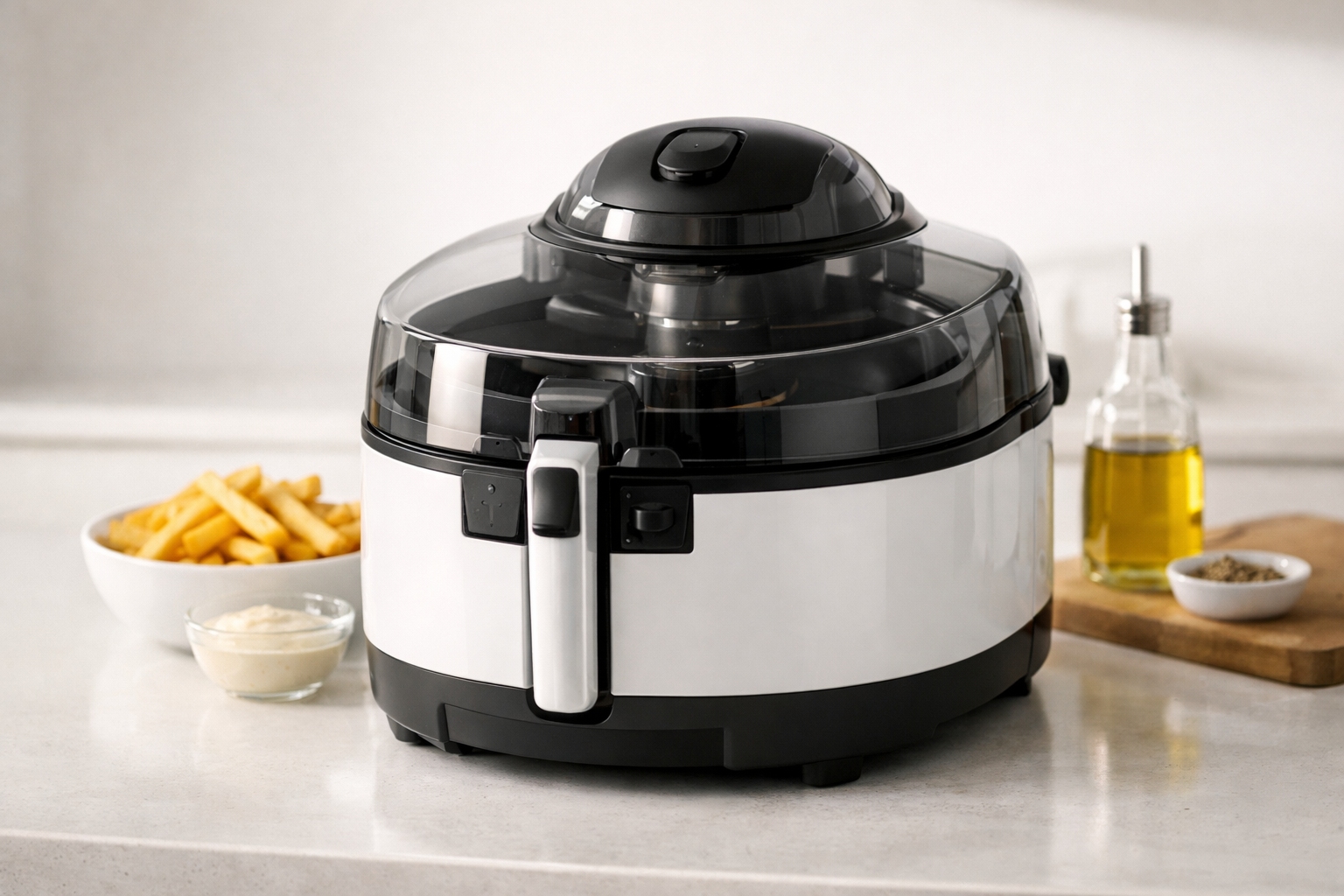
Bottom line: the De’Longhi MultiFry FH1394/1 is a 5.7 kg countertop multicooker built around a ceramic-coated bowl, removable stirring paddle, upper and lower heating elements and seven cooking programmes. It is best understood as a heated stirring pan with hot-air cooking—not as a compact pull-out-basket fryer.
This is a specification-led guide based on De’Longhi’s FH1394 manual, support pages and current accessory documentation. We have not hands-on tested this appliance.
- De’Longhi FH1394/1 at a glance
- What the FH1394/1 does differently
- The seven cooking programmes
- Capacity: what 1.7 kg actually means
- Using the paddle correctly
- Safe setup and daily use
- Cleaning without shortening coating life
- Exact parts and model-code checks
- FH1394/1 versus FH1363
- Used-buying checklist
- Verdict
- Frequently asked questions
- Is the FH1394/1 capacity 1.5 kg or 1.7 kg?
- Does FH1394/1 preheat?
- Can the FH1394/1 bowl go in a dishwasher?
- Why does the paddle start late?
- Is FH1394/2 the same as FH1394/1?
De’Longhi FH1394/1 at a glance
| Specification | Verified FH1394 detail | What it means |
|---|---|---|
| Fresh potato maximum | 1.7 kg unpeeled weight | This is a recipe maximum, not a bowl-volume measurement. |
| Frozen potato maximum | 1.5 kg | Frozen potatoes require no added oil in the manual’s table. |
| Upper heating element | 1,400 W | Provides the primary hot-air heat. |
| Lower heating element | 1,000 W | Supports baking, browning and pan-style cooking from below. |
| Programmes | Seven | Potatoes, pizza, cake, casserole/risotto, oven, airgrill and pan. |
| Bowl | Round, ceramic-coated, with removable paddle | The paddle stirs selected foods automatically. |
| Dimensions | 395 × 325 × 290 mm | It needs appreciable worktop space and clearance above the lid. |
| Weight | 5.7 kg | It is not designed for frequent lifting into and out of a cupboard. |
De’Longhi’s current FH1394 support centre links the manufacturer’s instructions. The company’s capacity guidance lists 1.7 kg of fresh potatoes and 1.5 kg of frozen potatoes for the FH1394 family.
What the FH1394/1 does differently
Most current air fryers hold food in a perforated drawer and rely mainly on a fan-driven upper heater. The FH1394 uses a solid bowl, an optional automatic paddle and heat from above and below. That architecture lets it handle foods a basket fryer cannot stir by itself: risotto, casseroles, sauces, soups and braised dishes, as well as potatoes and breaded foods.
The transparent lid allows visual checks during cooking. Depending on the selected programme, opening the lid either pauses ventilation and timing or lets cooking continue. The manual makes that distinction programme by programme, so it is safer to follow the relevant setting than assume the same lid behaviour every time.
For a broader explanation of heating layouts, see our guide to air-fryer and multicooker technology.
The seven cooking programmes
| Programme | Designed for | Paddle guidance |
|---|---|---|
| Casserole / risotto | Risotto, casseroles and stirred dishes | The paddle starts after roughly three minutes. |
| Cake | Cakes, muffins, biscuits and similar baking | Usually without the paddle; prepare the bowl as the recipe requires. |
| Pizza | Home-made or frozen pizza | No paddle; oil the bowl for home-made pizza or use suitable paper for frozen pizza. |
| Potatoes | Fresh or frozen chips, potatoes and croquettes | The paddle starts after a delay to avoid breaking frozen food. |
| Oven | Breaded foods, roast meat, fish, bread and vegetables | Use with or without the paddle according to the food. |
| Airgrill | Meat, fish, vegetables and final browning | Generally without automatic stirring for intact pieces. |
| Pan | Soups, sauces, jam, braises and light frying | The paddle can mix food like a saucepan that stirs itself. |
The first four are automatic programmes with default time and power settings. Oven, airgrill and pan are semi-automatic. Defaults can be changed with the power-level and timer buttons, which makes the display a programme controller rather than a direct temperature-in-degrees selector.
Capacity: what 1.7 kg actually means
The earlier page described FH1394/1 simply as a “1.5 kg air fryer.” That loses an important distinction. De’Longhi specifies up to 1.7 kg of fresh potatoes by unpeeled weight and 1.5 kg of frozen potatoes. The manual’s cooking table reduces oil and time as the fresh load drops:
- 1.7 kg fresh potatoes: oil measure level 5, roughly 40–43 minutes.
- 1 kg fresh potatoes: oil measure level 2, roughly 28–31 minutes.
- 1.5 kg frozen potatoes: no added oil, roughly 32–34 minutes.
- 500 g frozen potatoes: no added oil, roughly 24–26 minutes.
Those are manufacturer table values, not our test results. Food cut, starting temperature and ingredient moisture can change the result. Do not exceed the marked MAX level or treat the potato maximum as a universal capacity for wet casseroles or bulky meat.
Using the paddle correctly
The paddle is useful when food benefits from continuous movement. Fit it securely to the centre pin only when the programme or recipe calls for it. De’Longhi’s tables use the paddle for chips, risotto, meat sauce and some vegetables, but not for foods that should remain intact, such as cutlets or roast chicken pieces.
A short delay before the paddle starts is normal in some programmes. The manual specifically delays it for frozen potatoes so they are less likely to break. If the paddle does not turn immediately, wait for the programme’s planned delay before assuming there is a fault.
Safe setup and daily use
- Match the mains supply to the rating plate and use an earthed socket rated for the appliance.
- Do not preheat the appliance empty and do not run it without food.
- Keep the ventilation openings clear and avoid positioning the cooker beneath cupboards where released steam can collect.
- Never exceed the bowl’s MAX mark for liquid or the oil measure’s level 5.
- Move the appliance using its lifting handles—not the bowl handgrip.
- After the end-of-cycle beeps, switch the appliance off with the main on/off button.
These points come from the official FH1394 instruction manual. The appliance becomes hot during use and can release steam, so allow it to cool before cleaning or moving it.
Cleaning without shortening coating life
Unplug the FH1394/1 and let it cool. Remove the ceramic-coated bowl, paddle and viewing window, then wash them with hot water and neutral washing-up liquid. Dry everything thoroughly, including any water left under the bowl.
De’Longhi says the bowl is dishwasher-safe, but the same manual warns that frequent dishwasher washing can reduce the ceramic coating’s properties. Hand washing with a soft cloth is therefore the cautious default. Never use abrasive objects or detergent on the bowl, immerse the appliance body, or place the body under a running tap.
Clean the hot-air outlet without removing it and check the condensate tray regularly, particularly after steamy programmes.
Exact parts and model-code checks
Before ordering a replacement, photograph the rating label and record the complete suffix. De’Longhi’s current DLSK101 bowl-and-paddle listing names FH1394, FH1394/1 and FH1394/2 as compatible. It also lists other MultiFry models, which is why appearance alone is not enough to identify an appliance.
Check the bowl handle, centre paddle drive and seating against the original part. Electrical components and control assemblies should be matched by the full model and product code through De’Longhi support rather than by the family name alone.
FH1394/1 versus FH1363
Both families use a round bowl and automatic paddle, but the heating and controls differ. De’Longhi documents the FH1394 with a 1,000 W lower heater and digital programme interface. The FH1363 has a 200 W lower heater and simpler dial-based operation. Our MultiFry model-code guide explains why the exact rating-label code matters.
Choose FH1394/1 if you specifically want its programmed multicooker workflow, stronger lower heating and self-stirring bowl. A modern basket model is usually simpler for small portions of dry food and typically has fewer parts to clean.
Used-buying checklist
- Label: confirm FH1394/1 rather than trusting the listing title.
- Coating: reject a bowl with flaking, deep scratches or exposed substrate.
- Paddle drive: verify that the paddle, drive and centre pin are intact.
- Lid: check the viewing window, hinge and latch for cracks or looseness.
- Controls: test the selector, display, power levels and start/stop button.
- Heating: confirm that the appliance heats without E1, E3, E5 or E6 errors.
- Cable and body: reject melted insulation, burnt odours or improvised repairs.
The manual says E1 or E3 can require cooling and a check that the appliance was not run without food. Persistent E1/E3 and all E5/E6 faults require manufacturer support. Do not repeatedly reset a unit that smells burnt or trips the supply.
Verdict
The FH1394/1 still makes sense for someone who wants automatic stirring and a single bowl capable of potatoes, risotto, casseroles, pizza and baking. Its real strengths are the two-sided heating, paddle and programme selection—not vague promises of “perfect” results.
Its trade-offs are equally clear: a 395 × 325 mm footprint, 5.7 kg weight, more removable parts and a ceramic coating that benefits from careful hand washing. Verify the exact label, inspect the bowl and paddle, and decide whether the stirring-pan design fits the meals you actually cook.
Frequently asked questions
Is the FH1394/1 capacity 1.5 kg or 1.7 kg?
Both figures appear in De’Longhi guidance for different potato types: up to 1.7 kg fresh potatoes by unpeeled weight and 1.5 kg frozen potatoes.
Does FH1394/1 preheat?
De’Longhi’s manual says not to preheat the appliance empty. The programmed oven and cake workflows are designed without a separate empty preheat.
Can the FH1394/1 bowl go in a dishwasher?
Yes, the manual lists the bowl as dishwasher-safe, but it also warns that frequent dishwasher washing can reduce the ceramic coating’s properties.
Why does the paddle start late?
A delayed start is normal in some programmes. For frozen potatoes, the delay helps avoid breaking the food before it softens.
Is FH1394/2 the same as FH1394/1?
They are closely related FH1394 variants, but suffixes can affect product references and regional support. Match accessories and service information to the complete code on the rating label.
2 thoughts on “De’Longhi MultiFry FH1394/1 Guide: Programs, Parts & Capacity”